The content of this issue covers the field of website analysis for the first time in a long time. It talks about the "Google Tag" thing. Let me give you a preview that that one may not be so easy to read and understand. I am not familiar with them yet. In addition, I think the tools in points 4 and 7 are very practical. In addition, Gary explains the details of search engine principles in the podcast.
- [News] The fourth product review algorithm update and its impact
- [News] "Return Period" in product search results
- [News] New Structured Data – Pros and Cons
- [Technique] Scale judgment Redirect Mapping
- [Analysis] New Google Tag system
- [Official] Dynamic Rendering is not a long-term solution
- [Tool] Term Suggust – Free Keyword Research Tool
- [Tools] Bing Webmaster Tools Review
- [Video] Six tips for e-commerce merchants to stand out in Google searches
- [Abstract] The mechanism behind URL "removal"
[News] The fourth product review algorithmUpdates and Impact
Google launched the fourth Product Reviews Update (PRU) on July 27. It was originally expected that the algorithm update would take several weeks to launch, but this time it wasCompleted in 8/2。

The SEO community generally thinks that this PRU is a bit strange. In addition to being completed in only six days, major ranking tracking tools also show thatThe fluctuation is not severe, but there are still peopleReturnIts review site was affected. In any case, there have been four product review algorithm updates since the first in April last year, which means that Google attaches great importance to "high-quality reviews" and cannot be underestimated.
Link: Product Review Algorithm Update (First time / Second time / The third time) / Google High Quality Review Guidelines
[News] "Return Period" in product search results
When searching for products, sharp-eyed foreign netizens found information such as "average shipping time", "return period"... etc. appearing on the SERP. But what’s interesting is that this information is not mentioned on the product page, but comes from the “Shopping Experience Scorecard” in Google Merchant Center.

The "Shopping Experience Rating Scale Project" was launched in February this year. Merchants can upload product-related information (such as average return cost and other 4 indicators) through Google Merchant Center. Google may give badges to merchants that meet certain conditions, and even allow merchants to obtain prominent placements in the "Shopping" tab.
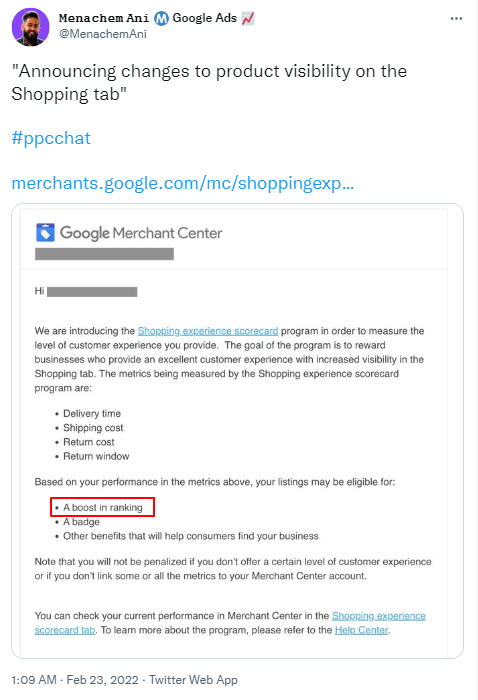
Since the announcement mentioned that this score may be a "boost in ranking", and the information required for the "Shopping Experience Evaluation Form" is actively uploaded by the merchants, Someone in thecommunity is discussingIs it suspected that merchants have lied and uploaded false data to manipulate rankings? In response to this matter, a Google spokespersonAlan Kent replied: "Google has ways to verify whether the information provided by merchants is correct. If merchants try to provide wrong information, they will be excluded from this project."
link:SER’s report on Shopping Experience Scorecard
[News] New Structured Data - Pros and Cons
Google has launched a new structured data - "Pros & Cons (Pros & Cons)" allows you to see the advantages and disadvantages of a product review in the search results.

This new search appearance is inMore than six monthswas first noticed, but only recently officially announced support for its structured data. In the official announcement, Google said that they will identify the pros and cons of data on the web page and may automatically present it in the search results (although no structured data is added), but if you can actively submit the pros and cons through structured data, it can help Google understand.
// Pros & Cons 結構化資料範例
<script type=“application/ld+json”>
{
“@context”: “http://schema.org”,
“@type”: “Product”,
“name”: “Cheese Knife Pro”,
“review”: {
“@type”: “Review”,
“name”: “Cheese Knife Pro review”,
“author”: {
“@type”: “Person”,
“name”: “Pascal Van Cleeff”
},
“positiveNotes”: {
“@type”: “ItemList”,
“itemListElement”: [
{
“@type”: “ListItem”,
“position”: 1,
“name”: “Consistent results”
},
{
“@type”: “ListItem”,
“position”: 2,
“name”: “Still sharp after many uses”
}
]
},
“negativeNotes”: {
“@type”: “ItemList”,
“itemListElement”: [
{
“@type”: “ListItem”,
“position”: 1,
“name”: “No child protection”
},
{
“@type”: “ListItem”,
“position”: 2,
“name”: “Lacking advanced features”
}
]
}
}
}
</script>
It is worth noting that this structured information can only be added to the editorial product review page, and does not apply to product pages or general customer review pages. In addition, this new feature currently only supports 10 languages, and Chinese is not one of them.
[Technique] Scale judgment Redirect Mapping
Redirect Mapping is an important step in website relocation. The purpose is to match the old URL with the new URL and set up a 301 redirect so that the traffic going to the old URL can be directed to the correct location. It is not difficult to create a Redirect Map when relocating a small or medium-sized website, or when the URL structure is the same. However, when the URL structure changes and the number of web pages is huge, it becomes a headache.
This article teaches two methods, which can effectively identify where the old URL should go when encountering the latter situation. The first one was introduced in the previous issueFuzzy Matching, upload two strings of URLs, and determine which two URLs should be paired together based on the similarity of the URLs. The returned results are not always correct, so you still need to check whether the combination with a low Similarity Score is correct.

Another method is to first download the keywords that ranked before the website was moved, and then use Google to searchkeyword site:www.newdomain.com, judging from the SERP, which webpage Google ranks first, it may be the most relevant webpage. Finally, Python is used with a paid API to scale the above steps.
The author has provided Python code for the above two methods in the original article, which is not difficult. I recommend that you try it out when you have time!
link:Redirect at scale
[Analysis] New Google Tag system
Google released in early AugustAn announcement, said that they will use a "Google Tag" to integrate and manage all different tags. For example, there is an AW-567890 (tag for Google Ads) and a G-123456 (tag for GA4). The two can be combined and managed by the same Google Tag.

Currently, you can enter the Google Tag management interface from GA4 and Google Ads to integrate different tags.

Integrated tags have little impact on small and medium-sized websites, and only those with very complex tag management and data collection requirements will see its benefits. In addition to sharing event detection (event detection), cross-domain tracking (cross-domain measurement), etc., the integrated tag will also share otherCoverage。

To be honest, I dare not say that I understand it 100%. If you want to study in depth and clarify, I highly recommend reading it. Article written bySimo(Although it is more colloquial than the official announcement, it is still difficult to read). This change is less relevant to SEO itself, but I think it is news worthy of attention and I would like to share it with everyone.
[Official] Dynamic Rendering is not a long-term solution
Someone noticed that Google was explaining Files forDynamic RenderingAt the top, a red text was added that read "Using dynamic rendering to allow search engines to see the content produced by JS is only a temporary solution. In the long term, we still recommend server-side rendering, static rendering, or hydration.」
In the early days when Google’s processing capabilities for JS were not strong, it was recommended that you use dynamic rendering so that search engines could directly receive the rendered content. However, this is already outdated information.evergreen googlebot launched in May 2019(using the latest version of chrome as the rendering service), Google no longer recommends dynamic rendering, which was the case in the pastMartin actually mentioned it many times, this time only the official document has been updated to reduce the circulation of outdated information.
If you don’t know much about the differences between several renderings, you can listen topodcast episode 6, or readthis article。

[Tool] Term Suggust - Free tool for keyword research
Came across this free keyword research tool developed by Joe Hall -Term Suggest, the user enters a keyword,This tool will automatically add a, b, c..., x, y, z after the word, and add who, what... and other words in front of the word, and use the Query Suggest API one by one to see the recommended related words.。
For example, I entermoet hennessy, the tool will
Throw the wordsmoet hennessy a、moet hennessy b、what moet hennessy... into the API, and then organize the returned results into the following format. The tool is completely free and not slow.
Return results of

This tool is free and fast to use. I recommend it to everyone. Digital Engine has previously writtenan articleteaches how to extract autocomplete data. The code is actually only a few lines, but if you can combine some creativity, you can make a more useful tool like Term Suggest. I recommend it to readers who are interested in writing programs!
link:tool website / video introduction
[Tools] Bing Webmaster Tools Review
Bing Webmaster Tools underwent a major overhaul in 2020. At that time, many features were launched that surprised everyone, but unfortunately they were not mentioned again. Although Bing has a small market share in search engines, BWT is useful as an SEO tool. It is completely free andVerificationis very simple.
Someone was recently The useful parts of Bing Webmaster Tools (BWT) have been reorganized onTwitter, so I thought I could bring it up for review:
- can be used as a website health diagnosis tool. It will list the areas where there is no title tag, meta description is too long or too short, etc. that can be optimized.
- provides external links. In addition to seeing links to your own website, you can even enter your opponent's website to analyze the source of your opponent's external links.
- The website structure is classified according to the URL. You can view its performance or crawling/inclusion status in subfolder units.

Digital Engine has been introduced in the past e-newsletter. If you missed it, you can go back and review it:Issue 3、Issue 9、Issue 10、Issue 13、Issue 16、Issue 19。
[Video] Six tips for e-commerce merchants to stand out in Google searches
This video episode shares six ways to make your web page look more prominent in search results. There is no new SEO information, but it is a good compilation. The video content is also very specific to the common situations of e-commerce types.
- ensure Howtitle linkis generated- E-commerce websites tend to use product attributes to automatically generate titles. Be careful when the attribute data does not exist or is wrong.
- Put high quality pictures- Width minimum 1,200px
- structured data- Product information is also available through Google Merchant Center
- Price Reduction Information- Applies to single price product pages only
- provides product ID- exampleGTIN, so the page might be placedTop Product CarouselMedium
- Registered Merchant Profile- Only merchants with physical stores
[Abstract] The mechanism behind URL "removal"
This episode of the podcast returns to an earlier in-depth series where Gary explained how search engines work. It is not as simple as it seems on the surface for a search engine to "remove" a web page, because there are different mechanisms in the three stages of crawling, indexing, and serving, and their respective mechanisms may conflict with each other. For example, if disallow (crawling stage), and put noindex (indexing stage), then the "URL" of this web page may still be indexed.
There is no way to remove the URL during the Crawling stage. In addition, Gary specifically said that he believed that robots.txt should only be used in the crawling stage. A few years ago, Google decided to no longer support robots.txt. This is also the reason for thenoindexinstruction.
Most of the real removal occurs in the indexing stage. Even when Google sees noindex in x-robots-tag or the URL itself is 404 in the crawling stage, the crawling stage only passes this information to the indexing stage to make decisions.
Removal in the serving stage refers to the URL removal tool in GSC. The URL here is not really removed from the index (index), but is only "hidden" in the search results, because removing the web page from the index will need to be synchronized to all data centers, and this process may even take several months.
The above summaries may seem simple, but in practice search engines may encounter very complex situations. For example, there are several URLs strung together with hreflang. Some of them are marked with noindex, but the rest are not. Since hreflang treats them as the same "document", all pages may not be included. For many extreme cases, Gary even said that he was not sure what would happen, but the only sure advice was to avoid such conflicting signals.
The following are some of Gary’s previous in-depth discussions on the principles of search engines. If you are interested, you can go back and listen:
- Canonicalization & Dupe Detection
- Serving & Hreflang
- Query Parsing & Query Understanding
- Serving Index
- Caffeine
- Rendering
link:verbatim draft
Search Quality Rater Guideline also had a revision in August, but after looking at it, there were no major changes, so I skipped the effort of chewing on words. Interested readers can read the one compiled by SEL.Revision information。