This time's e-newsletter contains more concepts and news-type information. The tool-related content is either similar to what was shared in previous episodes, or there are too few opportunities to use it. However, the articles or news shared are highly recommended for SEO newbies or friends who are unfamiliar with the topic. Even for me, reading it again will benefit a lot!
- [News] Error in index coverage report in GSC
- [News] Google Search On 2021 Summary
- [Reference] SEO decision-making flow chart
- [Official response] How does Google deal with website server crashes like Facebook’s?
- [Good article] SEO best practices for content reprinting
- [Tip] Google Discover search parameters
- [Official Document] How to write the title and description of a web page
- [Official Document] SEO Best Practices for E-commerce Websites
- [Concept] Will the case in the URL affect SEO?
- [Podcast] Google Search Podcast – Gary and Martin argue over JavaScript
[News] Error in index coverage report in GSC
Recently, Lily Ray mentioned on Twitter that there was an error in the "Index Coverage Report" in GSC. Unexpectedly, there was a response. Many SEOs (including myself) have also experienced the same problem.
appears as "Crawled - currently not indexed (Crawled - currently not indexed) "" URL, if you use the "URL Inspection Tool", it will show that the page has been indexed, and these pages can indeed be found on Google.
In this regard, the official explanation is that the "Index Coverage Report" is originally updated at a slower speed, so it is normal to have differences in data, and the "Website Check Tool" should be used mainly. But there isSEO return98% of the web pages on its website show that they are not included (but in fact they are included), so it is not as simple as a delay.
Twitter/X Post
View original post on Twitter/X
[News] Google Search On 2021 Summary
Google Search On comes to the second session this year, although it is not asLast year’s activitiesIn the SEO world becausepassage retrievalcaused a whirlwind, but we can still see the future prospects and direction of Google's search in this area. Which is also related toMUM at Google I/O this year(machine learning domain model) is closely related.
1. Help consumers find search inspiration (Article)
mainly mentioned three points, (1.) Use Google Lens to assist in the shopping process. Users can select an area (product) and search when seeing a picture; (2.) To shop on Google search, useGoogle’s Shopping Graph's technology integrates products, prices, reviews, inventory, brands, styles, etc. to provide a complete and rich shopping environment; (3.) Integrating physical shopping (in-store), users can see the inventory status of merchants near their area, integrating online and current shopping experiences.
2. The combination of AI and search (Article)
This section talks about MUM (a new milestone in machine learning) and what changes its implementation can bring to search. Users will be able to perform very complex and even cross-domain (text vs. image) search commands, such as searching for a patterned shirt.pictures, enter a paragraphtext「Found socks with this pattern" to get the result. In addition, with the help of MUM, Google will also suggest broader or more specific search topics on the SERP to help users who are not sure what they are looking for search.
3. Additional information on search (Article)
This is more like a PR section, talking about how to make users trust search results, which mentionedAbout this resultprovides more information about the website; fact check’s fact checking mechanism prevents the spread of false news; and inNo relevant results foundwill also be honest when talking about it.
4. Progress on Google Maps (Article)
said that Google Maps can integrate other information, such as wildfire areas or green space coverage areas, and it has become a more versatile tool. Another interesting thing isPlus CodeThis project can help the country establish its own address system. It may be difficult for people living in advanced countries to imagine, but many developing/undeveloped countries do not even have a complete address system.More than 4 minutes of videoI recommend everyone to take a look.
link:The Verge reports / Seven-minute highlights / full video
[Reference] SEO decision-making flow chart
this pagehas a collection of decision-making flow charts (flow charts) for various SEO situations compiled by Aleyda Solis. The decision-making flow chart is a schematic method that I like very much. It is very clear how to proceed under any circumstances. On this website you can see for example "Should the Faceted Navigation page be included?」、「Is it time to pursue a certain SEO project or opportunity?」、「How to determine whether to optimize, remove, or merge a page?"...waiting for such a question.
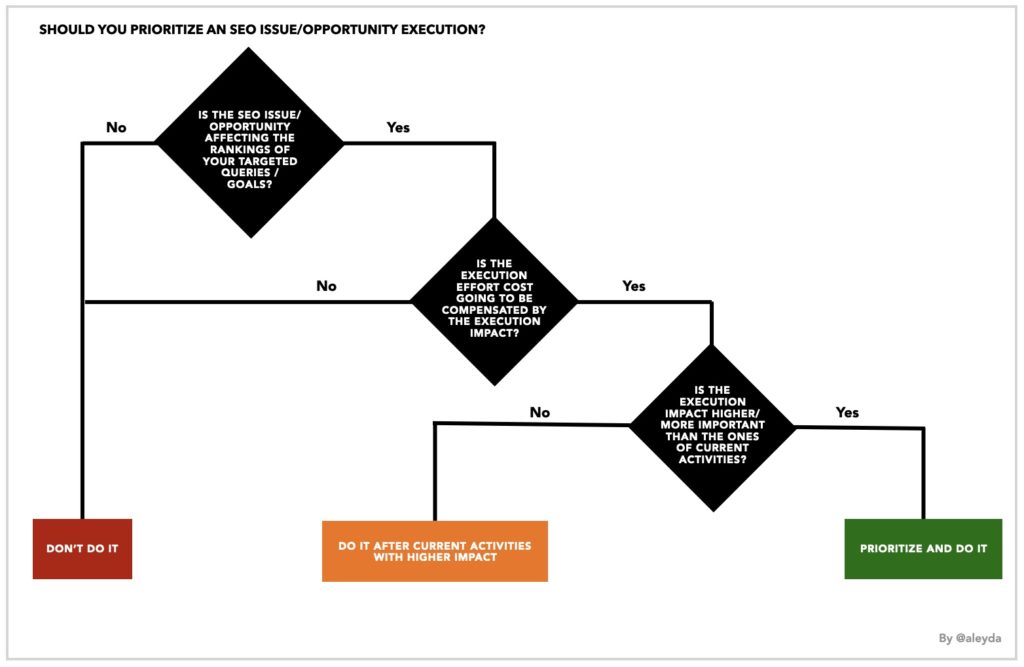
One of the benefits of looking at such a flow chart is that it can increase your horizons. Although some SEO decisions may seem easy, in other circumstances, there may be considerations that outsiders may not expect. Of course, conversely, such a flow chart may ignore some details and situations, so remember to always take the situation of the website you manage as the standard.
[Official response] How does Google deal with website server crashes like Facebook’s?
Very usefulFacebook crashesI believe everyone has heard of it, but if the website you manage encounters such a situation, how should SEO respond? How does Google view the situation of website server explosion? On Twitter, John Mueller explained Google's point of view a little bit.
- When the server does not respond or 5XX occurs on the website, Google will first reduce the frequency of crawling
- When this situation continues for 1 to 2 days, Google will begin to gradually remove these web pages from the index.
- This is usually the casedoes not directly affect rankings, Google will not feel that the web page quality is low or the content is not good.
- After the server problem is fixed, the web page will appear in the search results again, and the crawl frequency will gradually recover.
Twitter/X Post
View original post on Twitter/X
link:Official Document - How to properly suspend a website from Google search
[Good article] SEO best practices for content reprinting
Google does not like duplicate content, but content syndication is an indispensable part of the Internet ecosystem, especially in the journalism industry, which has its complexity.
Barry Adams is a well-known expert in News SEO. This article discusses how Google handles duplicate content in three important stages (crawl, index, rank), Google's official recommendations, what to do when reprinting other people's content, and what to do when providing content for others to reprint. I recommend SEOs who are still unsure about this topic to read this article!

link:Best Practices for Content Reprinting
[Tip] Google Discover search parameters
I personally like to use the little trick of search parameters. Simply put, it is to add some parameters to the "website address" of Google SERP to achieve the filtering effect. For example, add after the URLnum=100can increase the number of search results to 100 on one page; addlr=lang_zh-TWcan only run Traditional Chinese results...and so on.
I recently learned something new, that is, Google Discover can also use parameters to simulate web page results in different situations. First, change the browser to mobile mode, and then modify the main three parameters -q(change search term),lr(change language, andtbs=qdr:(change time range).
https://www.google.com/search?q=%E8%8B%B1%E9%9B%84%E8%81%AF%E7%9B%9F&ibp=tpf;cl_tp:srp,ui_tp:gst&lr=lang_zh-TW&tbs=qdr:w
Twitter/X Post
View original post on Twitter/X
link:Search result parameter application
[Official Document] How to write the title and description of a web page
Google has continued to release new information about the new SERP title generation mechanism in August. Recently, they have rewritten two articles on how to write titles and descriptions for web pages. In the title of this article a new term appears - "
"title link" refers to the title of the web page on the SERP. The source of the title link may be HTML <title> tag, h1, text that looks like a title on the web page...etc.

The other parts are more principled best practices, including how to write and what to avoid, nothing too special. The article described mentioned some more technical things, includingnosnippet、max-snippet、data-nosnippetThese are relatively rarely encountered HTML attributes. If you are not familiar with them, you can take a look.
link:Control web page title / Control web page appearance
[Official Document] SEO Best Practices for E-commerce Websites
Google has published a series of articles (in Chinese!) discussing SEO best practices for e-commerce websites. Google Shopping becomesFree PlatformIt has been nearly a year. During this period, we also tried our best to launch various updates related to e-commerce websites or products, includingCameo video appears on product knowledge graph、Tracking and comparison of product prices on different websites、launches more product-related structured information...wait, here are these articles again.
There are several chapters that I think are particularly worth reading, including "provides product information to Google", there is a paragraph mentioning how to upload product information to Google Merchant Center; and "launches new website "", what to do when the website is launched but not yet open for purchase.

[Concept] Will the case in the URL affect SEO?
insearch engine crawler captureI have written about similar concepts in this article. Among the following six URLs, which ones are the same in the eyes of search engines, and which ones are different?
 A) https://darrenhuang.com/about-darren-huang/ (extra trailing slash)
 B) https://darrenhuang.com/about-darren-huang (starts with http instead of https)
 C) https://darrenhuang.com/ABOUT-DARREN-HUANG (uppercase)
 D) https://darrenhuang.com/about-darren-huang (missing www)
 E) https://darrenhuang.com/about-darren-huang?utm_source=facebook (extra tracking parameter)
 F) https://darrenhuang.com/about-darren-huang.html (後面多了.html的檔名)
has the answer in this article, and in the video below, John explains in more detail how Google interprets it. The answer is "all different." The use of uppercase or lowercase URLs in URLs strictly refers to different web pages, but Google also knows that such situations are usually caused by imperfect server settings rather than intentional human effort. Therefore, Google will try to determine whether it is accidental or intentional.
The job of SEO is to reduce the need for Google to "guess" your website. Regardless of the content or structure, the clearer the better. The video also mentions how to give Google clear signals to avoid ambiguity.
Finally, I will ask you a question. Is there a difference in the case of the disallow URL path in robots.txt?
[Podcast] Google Search Podcast – Gary and Martin argue over JavaScript
Gary Illyes and Martin Splitt have always liked to bicker over whether JavaScript is a good thing. This podcast does not include John Mueller, so the two chose this topic for a direct duel, discussing the origin and evolution of JavaScript, its benefits and disadvantages.
I won’t help organize the summary for this podcast, because this topic involves the historical evolution of a language, and requires a rich CS background to organize it concisely. I only have a small amount of research on JS, and I am not qualified for this role. However, this podcast episode roughly talks about JavaScript, which was originally a server-side language (called Mocha at the time). , was later used as a browser language (called LifeScript at the time), so its nature is not actually a language born for today's website design, but it evolved slowly. Due to some historical factors (there are more detailed stories in the podcast), people found that JS is very suitable for being used to do things related to websites, so they developed things like AJAX, In recent years, extended applications such as jQuery have been used to build frameworks for websites using JS as the base, such as React, Angular, and Vue.
Both Martin and Gary were born in the background of developers. Gary believes that JS is too "low-end", the definition is not rigorous enough, and it is prone to unexpected consequences. Martin does not deny this, but he also counters that evolution is like this, and JS has its convenience, although developers often use it in the wrong places very creatively. I would recommend this podcast to people who have some programming skills (even better if it’s JS) or developers. It’s quite interesting for two people to discuss while bickering, but if you have no experience at all, it may be a bit unfamiliar.
I recently returned to New York. Although I can’t say I like it, I have to say that it is really vibrant and there are all kinds of events happening everywhere. I recommend everyone to visit or live in this city if you have the opportunity.