This e-newsletter has taken the most time to write since its inception, and it should also be the longest issue. There are a lot of things worth talking about in the past two weeks, and some of them are particularly in-depth, such as the summary of the Chrome Dev Summit, Google’s antitrust investigation, and the final podcast discussing the future of SEO. Although I have summarized it in this article, just like learning everything, if you encounter something you don’t understand, it is recommended to read the original information yourself, or leave a message for discussion!
- [News] "Web experience update" is coming to the desktop version
- [Abstract] Chrome Dev Summit 2021
- [Controversy] Antitrust charges against AMP project
- [News] Google announces its crawler IP address
- [Survey] Pricing survey of digital marketing industry
- [Interesting] The evolution history of search results (SERP)
- [Tool] Sandbox: SERP Competing Website Comparison
- [Tip] Track "rage clicks" in GA through GTM
- [Video] Timestamp of the video being searched (Key Moments)
- [Abstract] Google Search Podcast – The Future of SEO
[News] "Web experience update" is coming to the desktop version
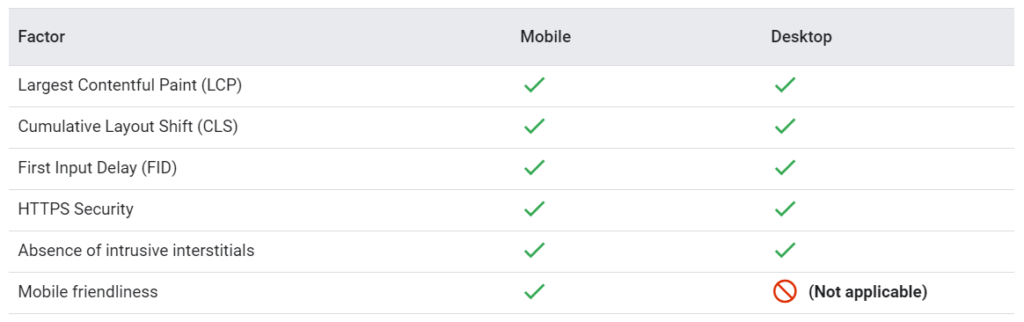
last yearMayannounced until this yearearly SeptemberJust completed the installation "Page Experience (PX) updates”, the official announced that it will be integrated into the desktop (desktop, laptop, tablet) web page ranking algorithm in February 2022, and is expected to start from February to the end of March next year.
in other words,Web page experience factors, including the familiar LCP, FID, CLS, intrusive interstitials, etc., as well as their associated passing standards, will affect the ranking of the website in desktop searches.. However, based on the experience of mobile version implementation, the degree of impact should beNot too big。
Twitter/X Post
View original post on Twitter/X
link:Official announcement / SER report / Google I/O preview
[Abstract] Chrome Dev Summit 2021
The Chrome Developer Conference was held in early November. Although most of it was related to website development, online privacy and security, etc., there were also some things worthy of SEO attention. I would like to share a few key points that I saw.
1. Lighthouse new features
The current Lighthouse has two major shortcomings. The first is that it can only simulate the cold load performance of the website in a clean environment, and the second is that it does not track the performance of the website after it is loaded. In other words, there is no way to test the performance of the website with a cache or service worker, and to catch the plate displacement phenomenon that occurs when the page scrolls, for example.
The new "User Flows" function is to allow us to see a more comprehensive web page performance when debugging.

2. Two new web experience metrics -ResponsivenessandSmoothness
Previous interviewCore Web Vital project manager and Tech Lead's podcast mentioned that web page experience indicators will evolve. This event also provided a more in-depth discussion on these two indicators that are under development.one isResponsiveness, the current FID can only calculate the delay of the first interaction with the web page, but does not consider the execution time of the event and the responsiveness of the web page that is not the first interaction;the other isSmoothness, everyone should have a similar experience when browsing the web. Some web pages will feel stuck or occasionally freeze when scrolling.Smoothness(Fluency) is used to quantify this bad experience.
in myWebsite experience metrics articlethat there are "core" indicators and of course "general" indicators. These two new indicators are still under development and are currently only general indicators, but they may become core indicators when they mature. (I personally thinkResponsivesshas a high probability of replacingFirst Input Delay。)
3. Browser built-in night mode (Dark Mode)
Chrome is developing a built-in dark mode in the browser, which uses an algorithm to visually switch the website to a black theme. I think this is very worthy of attention, because it means that after implementation, if the user's device or browser is set to turn on night mode, the UI of the website will not be what you designed.
The company's website has recently undergone a design transformation. I shared this news with the designer and he was quite devastated... Although there is an opt-out method, it is not a good user experience for users who choose night mode to see a website with bright colors.

link:2020 Chrome Dev Summit Summary / CDS 2021 event official website / CDS 2021 Official Summary
[Controversy] Antitrust charges against AMP project
AMP has been controversial all the way, but at the end of October 2021, a public formal charging document from 16 states in the United States attracted everyone's attention.The main complaint of this document is that Google’s underlying purpose of promoting AMP is to encourage websites to adopt the AMP architecture, thereby squeezing out competitors (advertising exchange platforms)。
Note: This prosecution has just been established and has not been concluded.Google has not received a formal reply so far.Therefore, this article only summarizes the prosecutor’s views, and the arguments contained therein have not been proven.
This complaint revolves around the technology of how websites make money through advertising. The two current mainstream methods are Header Bidding and Waterfalling. The former is considered to be a method that can bring more advertising revenue to the website, but it requires a piece of JS code to be placed on the website, so AMP pages cannot use Header Bidding. In addition,The complaint alleges that Google intentionally delays the loading of non-AMP ads by one second.(Item 249 in the document), to encourage everyone to switch to AMP.
There is also the controversy of Top Stories. Now everyone knows that AMP is no longer a condition for appearing in this placement, but before that, content media websites were somewhat coerced into transforming into AMP because of this large traffic pie placement, and used the Waterfalling advertising model that is more beneficial to Google.

link:Formal charging document (173 pages) / SEJ report / WP Tavern Article Introduction to / Header Bidding (Simplified Chinese)
[News] Google announces its crawler IP address
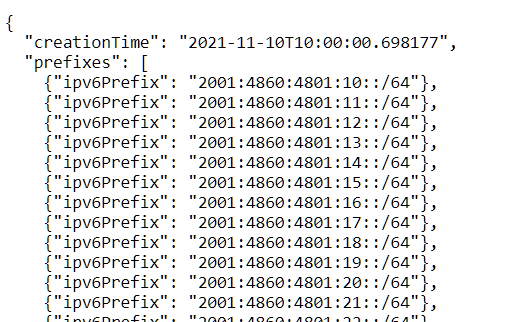
Google recently disclosed the IP address of the crawler source.Googlebotand othersGoogle Crawlers, the file is in JSON format and will be updated from time to time.
In some special circumstances, the website will need to verify whether the source of the crawl is a search engine (for example, when an opponent sends a robot to crawl website information) to avoid accidentally blocking the search engine request. In the past, the only way was to use reverse DNS lookup to check whether the requested IP was registered ingoogle.comor
Undergooglebot.com, to perform the verification action. Now that there is a public IP list, it is much easier for websites with the above needs.
Another convenient thing is that when doing log file analysis, you can also more accurately determine which are the real Googlebot requests. (Note:
The value ofuser-agentcan be set arbitrarily, so it is not trustworthy. )
link:Verify Googlebot / Verify Bingbot (still have to use reverse DNS lookup)
[Survey] Pricing survey of digital marketing industry
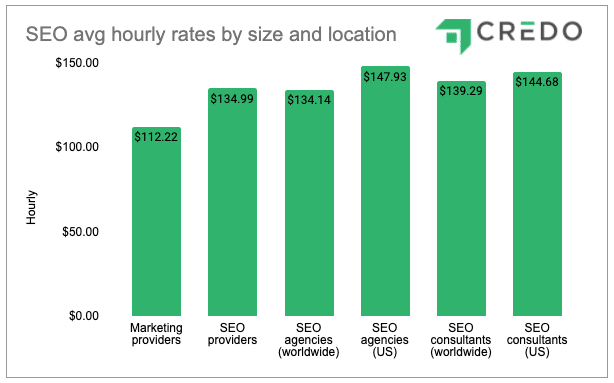
This study was launched by Credo. It received cases from 507 agencies or individuals with employees ranging from 1 to 50+, and investigated their charging standards for services such as SEO, PPC, and social media advertising. Below are some data that I find very interesting. If you want to see other fields or more detailed information, you can read the report yourself.
- ~63% of SEO agencies do not provide external link services
- ~78% of SEO agencies provide content marketing related services
- The average SEO individual case fee in the United States is $145 per hour.
- The average SEO agency fee in the United States is $148 per hour
- Regarding the minimum engagement length, about 30% responded that there is no such limit in their contracts; another 30% limit it to at least 6 to 12 months; and the remaining 40% limit it to 1 to 6 months.
link:Credo digital marketing agency fee report / SEJ’s SEO personnel salary survey
[Interesting] The evolution history of search results (SERP)
Someone used the archives on the Wayback Machine to sort out the search results pages (SERPs) of Google and Bing from 2000 to 2020. On this website, you can see the changes in Google search results (even single components) along the way, comparisons with Bing, and even what new components appeared in which year. It is quite interesting. If you want to see more, you can goSERP Evolution the websiteHave fun.

[Tool] Sandbox: SERP Competing Website Comparison
this"SERP Analysis"The tool allows you to enter a word and directly get the SEO information of each opponent on the SERP, including its actual (field data) and laboratory (lab data) user core indicators, loading screen partitions, web page content (title, description, h1, h2, word count...), and the structured data used.

In issue 20, another tool of this website is introduced "Google Says”, it can help you find what SEO official figures have said on Twitter. It is also very practical and I recommend you to play it.
[Tip] Track "rage clicks" in GA through GTM
"Rage Clicks" refers to users quickly clicking on the same area in a short period of time. It may mean that components on the web page do not respond as expected after being clicked, causing users to be unhappy. Generally, indicators for measuring this kind of on-page UX will be measured through Crazy Egg,Microsoft ClarityThis type of tool.
Personally, I would prefer to use ready-made tools, but if you don’t want to install additional code on the website, or want to learn a more advanced tag manager application, then this tutorial article teaches you how to set rage clicks as events and send them to GA through GTM (Universal GA or GA4 are both acceptable).

link:Portent articles
[Video] Timestamp of the video being searched (Key Moments)
In this video, Danielle explains how Google determines important time periods in videos. Although it is not a new thing, I believe many people are less exposed to it. There are basically two methods.1.)Leave it to Google to judge:Make sure the video URL can be crawled + usedSeekToActionmark;2.) Add timestamp manually: useClipmark. Both methods require the use of structured data.
What's also interesting is that in the case of machine judgment, Danielle gave several examples of machine learning technologies that Google will use, including using "Speech recognition" to judge what is said in the video, using "Optical character recognition" to judge the text on the video screen, and even "Visual signals" to judge what is happening in the video (such as the scene of a football goal).
link:Video structured data official document/ Digital engine past introduction (1,2)
[Abstract] Google Search Podcast – The Future of SEO
In this episode, the trio gathers again to discuss the future trends of SEO. There are many topics discussed, so I will pick a few points that I think are interesting to summarize. I recommend listening to them yourself when you have time. If you are usually involved in SEO, the English part should not be too difficult, and Gary’s speeches are very funny and relieve boredom.
Meta Tags- Meta tags allow webmasters to have some control over website content, so they should not disappear. But Gary said he hopes there won't be more meta tags in the future, as too many will only make it more complicated. He also cited a short story. He and John often jumped out to stop other teams when they wanted to launch new meta tags. For example, if someone wanted to launch a meta tag that allowed webmasters to control whether to allow web content to be automatically translated, they could add a new directive to the meta robots tag. A new meta tag was not required.
Structured Data / Canonical- Gary said that although Google currently encourages everyone to use structured data and has put a lot of internal resources into developing this area, he feels that at some point in the future, it is likely that even if the web page does not add structured data, Google will be able to understand the content and meaning of the web page almost without error. This is similar to canonical tags. When machine learning advances to the point where the ability to judge original content is very high, most of the time it doesn't matter whether the web page is posted or not. At that time, putting structured data and canonical tags on the web page may just be an act of reaffirming one's stance.
Active or passive crawling and inclusion- Bing recently promotedIndexNowallows webmasters to proactively push new or changed web pages to them. Although this method seems to be more efficient, both Gary and Martin remain skeptical, mainly because (1.) this may be unfair to small websites without technical resources, (2.) when this method is scaled up, the search engine side will need a prioritization method, (3.) when opening an external interface, it is difficult to avoid malicious attacks.
machine production content Contents produced by - machineis a big topic. They have seen the very high-quality content produced by the machine. Gary believes that their current position is mainly,If the content produced by the machine has not been reviewed by humans, then Google does not want to appear in the search results.; If someone reviews it before putting it online, it doesn't matter.
link:verbatim draft Another very important thing about
Chrome Dev Summit is "The New Responsive" concept, the responsive design in the website is no longer just about adjusting the web page layout according to the screen size. The new "responsiveness" is to design the UI according to user preferences (ex: reducing color contrast), new screen types (ex: folding screens), and the needs of different containers on the page. I have to say that I don’t understand it 100%, but I just know that front-end engineers and designers have new things to learn...