I really enjoyed this issue myself! Wise's case, search homogeneity, and the content in the podcast are all quite enlightening. They are not very common SEO discussion topics. I recommend that you find time to read the original English article when you have time. The following is the content of this issue:
- Case Study – SEO Strategy of Wise (formerly TransferWise)
- Recommended articles – Homogenization of search and SEO singularity
- Introduction to Screaming Frog’s “Compare” function
- Various free SEO templates organized
- Search Response – Pepople Also Ask Query Tool
- Google launches search and search budget quiz
- YouTube SEO Research Analysis by SEMRush
- Google Search Console Update – Simplified Page Experience Reporting
- [Video] How does user feedback impact search?
- [Abstract] Google Search Podcast – Web Worker & Universal Search
Case study: Wise (formerly TransferWise) SEO strategy
Wise is a fairly well-known European financial startup. In my mind, they are almost the Airbnb of the financial world. This company is often used as an example in the SEO circle. The first thing is that this year they successfully changed the company's website from transferwise.com to wise.com. The other thing is that they stood out in the very competitive financial field and successfully occupied most of the featured snippet positions.

This caseThe analysis takes everyone to understand Wise's five major SEO strategies - (1.) Landing pages that can scale; (2.) Customized CMS that can meet SEO needs; (3.) Content created for featured snippets; (4.) Various ways to attract external links; (5.) Successfully change the domain of a website with millions of pages.
Friends who are using Twitter are also welcome to follow Wise’s SEO -Fabrizio Ballarini。
link:Interview with Fabrizio (SEO @Wise) / [Video] SEO Strategy for Wise Redirecting / [Presentation] Building an SEO-friendly CMS
Good article - Homogenization of search and SEO singularity
Take a look at the picture below first. If you input a piece of text on the left, two rewriting methods are produced on the right. One is human rewriting and the other is machine rewriting. Can you tell which one is which?

In this article "The Search SingularityThe answer can be found in the article. The author believes that we are now at a revolutionary point in time. The content produced by machines is getting more and more advanced. The same content will be recited hundreds or thousands of times, and there will no longer be obvious differences in search.
Although there is no artificial intelligence, in fact, many times what SEOs do is to look at the already ranked articles on the Internet, organize and summarize them into a new article, and rarely add additional information or value. The increasing maturity of AI technology has taken this trend a big step forward. When the quality of content produced by machines reaches or even exceeds the level of human writing, what will happen to the entire search ecosystem, and how should SEOs adapt? The issues discussed in this article are worth pondering, and I recommend it to everyone!
Introduction to Screaming Frog’s “Compare” function
This feature, introduced in v15, allows users to compare the crawl results of a website with the previous one. Whether it is used as a website monitoring tool or a before-and-after comparison of major updates, it is quite good.

Several practical usage opportunities and analysis include (1.) After optimizing internal links, compare the changes in the number of internal links of the web page; (2.) After optimizing the website structure, compare the crawl depth; (3.) Compare the SEO elements of a single web page (title, description, headers, canonical...etc.); (4.) Compare specific folders and filter out which URLs the folder has more and less URLs at two points in time.
link:Compare Features Guide / v15 update record
Various free SEO templates organized
Various SEO templates compiled by The Gray Dot Company, including SEO performance report templates, technical health clinic templates, keyword research templates, content analysis or content briefings... and more, and they are all free!
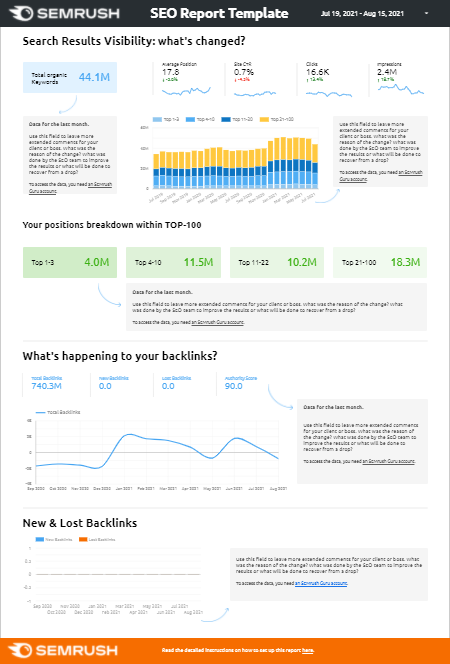
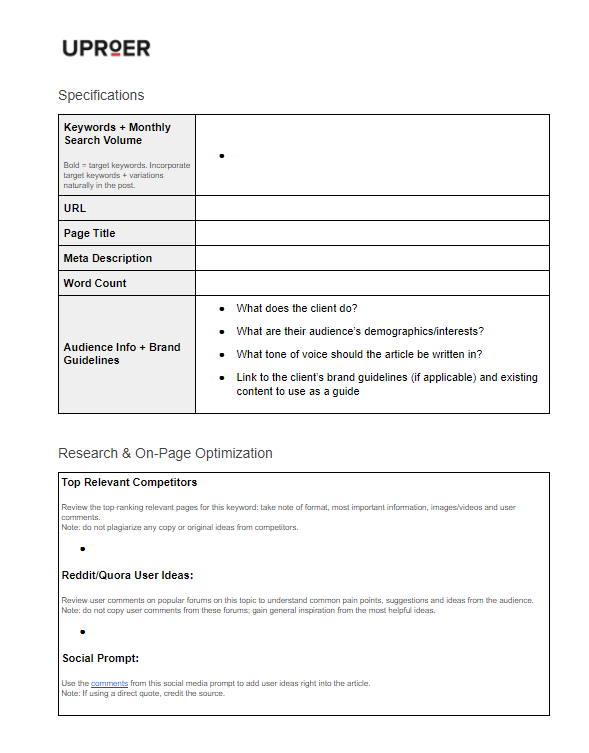

I recommend that you pick one you like and use it as a basis to develop a report template that suits you. If you have a private collection that you think is good, you are welcome to share it below~
link:The Gray Dot Company Article
Search Response - Pepople Also Ask Query Tool
This tool is still in the Beta testing stage, and I haven’t seen many people discussing it, but its designed functions and People Also Ask (PAA) analysis angle are quite interesting. Users can do the following things:
- Enter a word and see questions and answers containing that keyword.
- Enter a domain and see answers to questions from that website
- Enter a URL and see answers to questions from that page

The more common PAA query tools on the market are -AlsoAsked、Answer the Public、QuestionDB, although these tools are mainly in English, I think Chinese users can still use them to understand the user's problems, understand the gap between the content of their own website and the user's search intention, and produce corresponding content to fill it.
Google launches quiz on search and search budget
Google has added several new quizzes to its official documentation on crawl budget. The questions in them are very interesting, and there are some details that need to be paid attention to, so that they are not too simple.
If you are new to SEO, I have previously written an article aboutGoogle search Welcome to read's article. I will simply help you translate the question below. If you are interested, you can go and try it. You are also welcome to leave a message to discuss the answer.
- Does compressing the sitemap increase the search budget?
- Google prefers new content, so it is best to adjust (tweak) the web page from time to time
- Google prefers old content to new content (note: old content refers to content that has existed for a period of time, not outdated content)
- The faster a page loads and renders, the more pages Google can crawl
- Small websites are not crawled as often as large websites
- The closer the web page is to the homepage, the more important Google will consider the content.
- URL versioning (url versioning) allows Google to re-crawl
- Site speed and errors impact crawl budget
- search is a ranking indicator
- Alternative URLs (ex: AMP, hreflang) and embedded resources (ex: CSS, JS) are included in the search budget
- is available
crawl-delayControl Googlebot activity - linked
nofollowattribute affects retrieval budget
link:Google Search Quiz
YouTube SEO Research Analysis by SEMRush
SEMRush did this YouTube study, analyzing the top 10 YouTube videos for 15,000 keywords and trying to analyze and summarize the common characteristics of successful videos. Some of the conclusions, while not particularly surprising, are quite interesting. As more and more people start to run their own YT channels, I believe that everyone has been asked if there are any special skills in YouTube SEO.
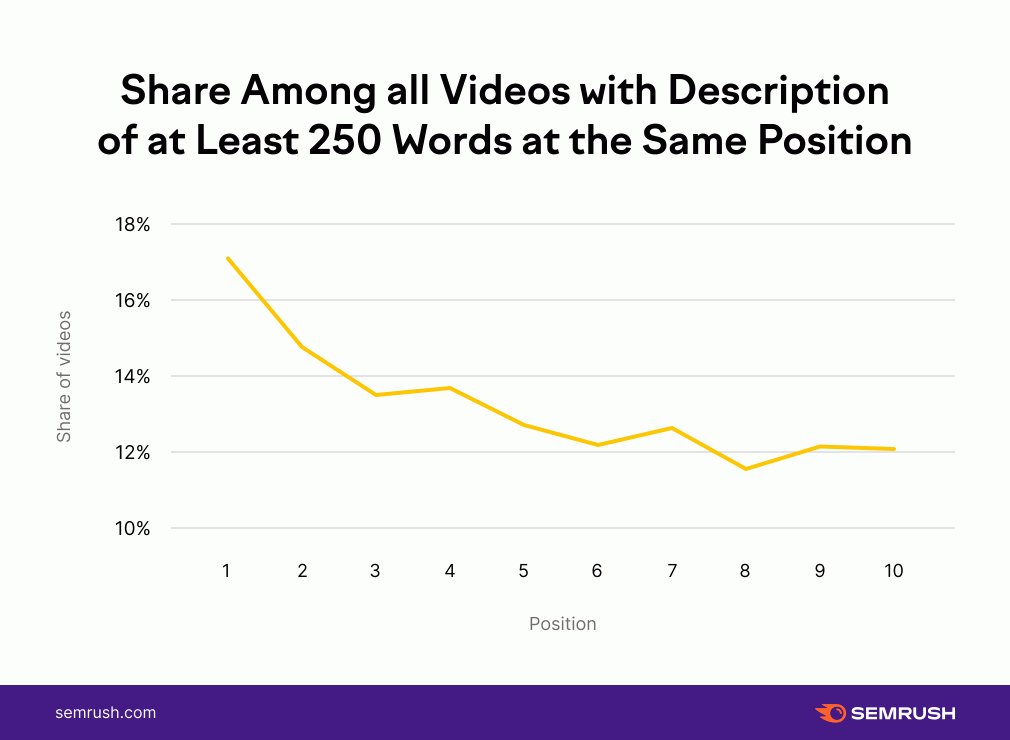
The article will give some practical examples, such as cases where small channels are ranked ahead of large channels, and the possible reasons behind them. It also quotes some official YouTube statements, so I highly recommend reading it!
link:SEMRush full text / YT SEO Guide introduced in Issue 28
Google Search Console Update - Simplified Page Experience Reporting
In this announcement, Google mentioned that they willSafe Browsinghas been removed from the web experience report in GSC because Safe Browsing is not a ranking factor for SEO and most of the time it is not within the control of the website owner. Still, Safe Browsing is important, it just has no bearing on rankings, so it will be removed from this report. (Note that Safe Browsing and HTTPS are separate things.)

Another one that was removed wasAd Experience (ad experience report), the advertising experience has never been a part of the web experience, so it is removed from the web experience report to avoid misunderstandings. If you want to determine whether the website has a bad advertising experience, you can useExclusive toolsjudge.
link:announcement
[Video] How does user feedback impact search?
In this video, John answers how users provide feedback and how Google digests this feedback. There are three main ways to contact us - (1.) "Submit Comments" at the bottom of the search results page, (2.) User Help Forum, (3.) Official social account.
As for the message part, it is best to specifically express the problem and its scale and provide a few search terms as examples, rather than just using it as a channel for complaints. It is important to know that Google usually makes overall changes to the algorithm rather than fine-tuning the search results for each word, and changes to the algorithm will need to be prioritized based on the scale and severity of the problem.
[Abstract] Google Search Podcast – Web Worker & Universal Search
Gary continuesfirst few episodesFor topics, Google first extends the words entered by the user into a parsed query, then sends it to the index database, pulls out relevant results, and sorts each result with a score. But there is more than one index library. In addition to ordinary web pages, there are also different index libraries for pictures, videos, news, etc. Each index library will receive this parsed query and return its results.
Although each index library returns a result, not all SERPs have pictures or videos. This is actually because there is a mechanism at the top, let's call it "Universal Mixer", which is responsible for piecing together what elements should be in the final search results. This most commonly used search function is called Universal Search, which not only sorts web pages, but also includes other results such as pictures or videos.
The way Universal Mixer selects which elements appear is like a bidding system. For examplefeature snippetSay it has a score of 1,000 and wants to compete for the first place position, whileWeb page indexIt also said that it had a result with a score of 1,500 and wanted to compete for the first place. The result was that the final SERP first place was taken by this web page result without a feature snippet.
Next, the user's behavior will also affect the judgment of Universal Mixer. For example, if many people search for a certain search term and then go to the "image search" results, then Google will learn that this search term may need to include an image field in the results of Universal Search.
John summed it up well, saying that Universal Mixer is actually like a search engine for search engines (web, image, news...etc)!
Front-end engineers or those who are more exposed to technical SEO may have heard of the technology of Web Worker or Service Worker. In this podcast, Martin first explains what it is and how it affects SEO. I have always liked listening to Martin talk about technical things. Although I had done a little research before, it was only after listening to his explanation that I felt enlightened. The following is my understanding. I recommend that everyone who is interested can listen to it for themselves. If there is anything wrong with the explanation, please help to prove it!
Service Worker is a type of Web Worker. Generally speaking, JS will use the main thread, and this technology allows you to execute code on other execution threads. In other words, usually when you click a button on a web page and then start running JS behind the scenes, your main thread is blocked until the JS is finished running, and there is no way to perform other events. However, web workers can allow the code to be executed in a separate environment, allowing the main thread to perform other actions.
Another biggest benefit of Web Worker is that it can execute code directly locally without going through the server. For exampleSquoosh.appThis image compression website compresses and converts images in your browser (local) instead of uploading images to the server, converting/compressing them, and then downloading them back.
The most commonly heard service worker application for SEOs may be PWA, which turns your website into an "APP" that can be installed. You can also run content when offline, send out push notifications... and so on. (Speaking of digital enginesmain websiteIt is PWA+AMP, and the above functions will also be available when browsing on mobile phones).
These relatively trendy technologies are more related to UX. Martin said that most applications will not affect Googlebot's crawling and indexing, but sometimes engineers are too creative and do some weird things that may still affect SEO. For example, the main thread only loads the template of the web page, letting the service worker load the content behind the scenes, and then pushes it to the main thread after completion. This may cause Googlebot to make judgments in the rendering phase without waiting for the service worker to complete the work.The web page is rendered but no content is seen.。
link:Verbatim (English)
was invited to participate in a session a while agopodcast, I don’t want to hear my own voice back, but I still share it with those who are interested 😅