The biggest news in this issue is that Google has modified their mechanism for generating SERP titles. Many SEOs have reported that their titles have been changed to be quite funny. This issue is divided into three paragraphs to share with you, which are the official position and statement, the reaction of the SEO circle and some funny examples, as well as useful detection tools. In addition, the data overlay and visualization tools introduced in article 4, as well as the part where Gary discusses how Google conducts search testing in the podcast, are highly recommended reading!
- [SERP title rewritten] Official statement and concept clarification
- [SERP title rewritten] Community discussion and examples
- [SERP title rewritten] Detection and analysis tools
- [Free tool] SEOgre – SEO data overlay + visual analysis tool
- [Case Analysis] The long-term and short-term impact of changing the "SEO Description" on the e-commerce category page
- [Template] Keyword search intent classification + analysis
- [Tip] Use Screaming Frog to crawl GSC web pages
- [Official Q&A]
Why didn't
site:run out of all my web pages? - [Abstract] Google Search Podcast – How Google conducts search testing
[SERP title rewritten] Official statement and concept clarification
Google began to modify the way web page titles are generated on search results pages (SERPs) in mid-August. In other words, the text set by the webmaster in <title> may be different from the page title on the SERP. It may be better, but it may also be worse. inAnnouncement In the discussion onand Twitter, there are several key points and concepts worth clarifying:
- Rewriting the title is actually not news, from
Starting from2012, Google may not necessarily use web pages
<title>as SERP title - Currently there are approximately80% web page
The SERP title ofis still in HTML
<title> - Previously, Google rewrote the title based on the user’s search terms. With the launch of the new system,Google now usually only uses one title, a title that best represents the page. (I say "usually" because someonenotedMobile phones and computers may use different titles)
- In addition to the original HTML title, the rewritten title may come from h1, header tags, text that looks like a title on the web page, all text on the web page, and even anchor text used by the back link source
- The SERP title of the web page no longer differs based on the search terms., this is different from meta description (source)
- The rewritten title has nothing to do with the ranking, being rewritten does not mean that Google ignored your original
<title>(source) - Rewrite title andFragment information retrieval (passage retrieval)Not relevant (source)
- If the web page changes
<title>, Google will review and select the SERP title after seeing it (source)

Google's most important policy when implementing changes is "whether this is good for users." Objectively speaking from the perspective of search engines, there are too many web pages on the Internet that do not have good<title>, let’s put aside the black hat tricks of spammers. There are many web pages on the entire network that are neglected to manage after they are created, and have no meaning.<title>(ex: home page, page 1...) or even none at all Web page of<title>.
Danny is heretwitter discussionShi also said that he had also thought about whether there could be a special "I really really mean it" tag to tell Google that this is the title that the webpage wants to be used, and please do not rewrite it. This shows Google's dilemma - it wants to use the information provided by the web page, but it may not be relevant.<title>; Or use your own method to pick out web page titles that are suitable for Google users?
[SERP title rewritten] Community discussion and examples
The title rewrite this time iswas launched first and then there was an official explanation, and although the overall user experience of Google may have improved, too many people reported that the title of their web pages was changed very strangely, so Google is alsoon the forumWe collect everyone’s feedback and hope to optimize this new mechanism. We recommend that if you see extreme cases, you can go and report them. Here are some victims of this change, so that everyone can feel better after seeing more tragic examples.
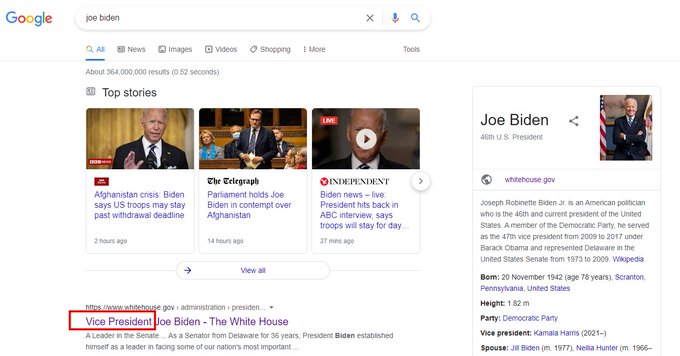
"Vice President" Biden
U.S. President Joe Biden only took office this year. Perhaps because he has only been president for a short period of time, most of the signals in the online world point to his former deeds as Obama's vice president, so Google changed his White House webpage to "Vice President Biden."
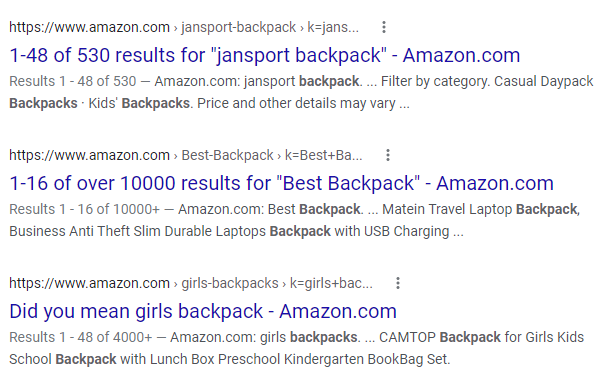
Amazon’s title is replaced with H1
The web page of Amazon, a giant e-commerce company, is inevitably rewritten. The <title> of the web page is ignored and replaced by the text that appears in <h1>. People can't help but wonder how this change will affect the CTR.
- Original title:Amazon.com : backpack
- Rewritten title:1-16 of over 100000 results for "backpack" - Amazon.com
WordStream web pages lost 37% of their CTR due to title rewriting
WordStream has a freekeyword research tools, whose title was changed from the original "Try WordStream's FREE Keyword Tool" was changed to "Learn More"About The FREE Keyword Tool", just the change of this verb caused the click-through rate of the webpage to drop by 37% without changing the ranking.

In addition to the above examples, there are many strange returns, such asurl slug is treated as title、The file name of the hero image is used as the title、Google Ads web page super irrelevant title...wait, some of them are funny, but when the page is aboutmedicalOrlawtime, this may be an issue that Google needs to reflect on.
Regarding this incident, I recommend reading to friends who are interested in learning more.Brodie Clark、Lily Ray、Dr. PeteArrangements made.
[SERP Title Reword] Detection and Analysis Tools
Most SEOs will feel at a loss when their titles are rewritten, but to solve the problem, you need to first know whether your website has encountered any problems. Although I have seen many strange titles that have been rewritten, the official statement is that only 80% of websites have encountered this problem. In this paragraph, I will introduce two convenient tools to help you check + analyze:
Google Sheets (template + 600 keyword queries per month)
existE-newsletter issue 34I have introduced this website in the article. The author has launched a new template. As long as you register with RapidAPI, you can get a free quota of 600 queries per month (no need to tie up a credit card). Copy the author'sTemplates provided, enter the keywords, region, language, and domain you want to query, and you can see whether your webpage has been rewritten.Complete teaching article。

SERP title check bookmarklet (bookmarklet)
I have written about bookmarks beforearticleExplain, you can go there to learn more. The method to use this tool is to right-click on the bookmark list of the browser to add a new web page, enter the following code in the URL bar, and then click on the small bookmark on the SERP. The example below will appear for you to compare the title of the SERP with the title of the web page.Complete teaching。
Bookmarklet code
javascript: (function (doc){var changed=0; function checkTitles(){console.log('jQuery version ', $.fn.jquery, ' loaded'); var position=1; var items=[]; var results=$('#rso .kp-blk .g, #rso .g[class="g"], #rso .srg .g').not('.kno-kp .g').find('div:first').find('a:first'); $('.title-changed, #CountTitlesChanged').remove(); results.each(function (){if (!$(this).parents('.related-question-pair').length){var parent=$(this).closest('.tF2Cxc').length > 0 ? $(this).closest('.tF2Cxc') : $(this).closest('li'); items.push([ position, $(this).find('h3').text(), encodeURI($(this).attr('href')), parent]); position++;}}); var numItems=1; cors_proxies=[ 'https://api.codetabs.com/v1/proxy?quest=', 'https://jsonp.afeld.me/?url=',]; items.forEach(item=>{$.ajax({url: cors_proxies[Math.floor(Math.random() * cors_proxies.length)] + item[2], success: function (data, status, xhr){title=$(data).filter('title').text(); var html='<div class="title-changed">'; if (title !=item[1]){html +='<span style="font-weight: bold;color: #ff6961;">' + title + '</span>'; changed++;}else{html +='<span style="font-weight: bold;color: darkgreen;">' + item[1] + '</span>';}html +='</div>'; item[3].find('div').first().append(html);}, error: function (xhr, status, error){var html='<div class="title-changed">'; html +='<span style="font-weight: bold;color: lightslategray;">抓取失敗</span>'; html +='</div>'; item[3].find('div').first().append(html);}, complete: function (xhr, status){if (numItems==items.length){petitionCompleted();}else{numItems++;}}});});}function petitionCompleted(){$('#result-stats').append('<span id="CountTitlesChanged"> - ' + changed + ' títulos cambiados en esta página</span>');}if (typeof jQuery=='undefined'){var script_jQuery=document.createElement('script'); script_jQuery.src='https://code.jquery.com/jquery-latest.min.js'; script_jQuery.onload=checkTitles; doc.body.appendChild(script_jQuery); console.log('script_jQuery appended to body');}else{console.log('jQuery already included ...'); checkTitles();}})(document)

[Free Tool] SEOgre - SEO data overlay + visual analysis tool
This is a free tool provided by iPullRank, which allows webmasters to combine GSC, Ahrefs, SEMrush, GA... and other data, using the timeline as a join key, and combine it with the algorithm change date provided by the tool itself to see the overall trend changes.

SEO will need this kind of perspective to some extent when analyzing. You need to know the changes of a certain website or algorithm and compare them with KPIs. In addition to quickly helping you complete such things, this tool also has another point that I think is worth recommending.The parameters of the vertical axis use relative values, so you can compare traffic, exposure, click-through rate, ranking, conversion, number of external links...etc. at one time. Finally, in addition to analyzing your own website, you can also use this tool to analyze competing product websites!
Link: SEOgre Tools / tool introduction (text + video) /
[Case Analysis] The long-term and short-term impact of changing the "SEO Description" on the e-commerce category page
On e-commerce category pages, it is common to see a corner filled with a bunch of "text". The purpose is to have more text content and keywords in the category page with less text. Although this content is usually not read by users. However, if this text area is to be removed, SEOs will worry that the ranking will drop without text support.
This kind of dilemma is quite common in SEO. Glenn Gabe shared this case, telling about an e-commerce client he dealt with who decided to shorten the description of the category page in three stages. What was changed in each stage and the results, as well as the traffic/ranking changes of the website after several core algo updates.
Phase 1 
Phase 2 
Stage 3 The final result of
is positive, but this is just a case. It is recommended that you read the case in full when you have time, instead of just capturing the final results and ignoring the context.
link:case analysis
[Template] Keyword search intent classification + analysis
SEO often analyzes users' search intentions to ensure that the content on the website covers different stages of the consumer journey. This consumption intention is generally divided into: (1.)Informational- Users want to find information to solve their doubts, (2.)Transactional - The user wants to take a certain action (ex: purchase or registration) to solve the demand, (3.)Navigational - The user wants to find a specific website or page.
The following template classifies search intent and determines the performance of the website at different search intent stages. The template is in English, but the article explains how to classify it, and it can be modified to suit the conditions of your own website. In addition, the author divides search intentions into four categories. I think there is no absolute right or wrong in this classification, just personal habits~
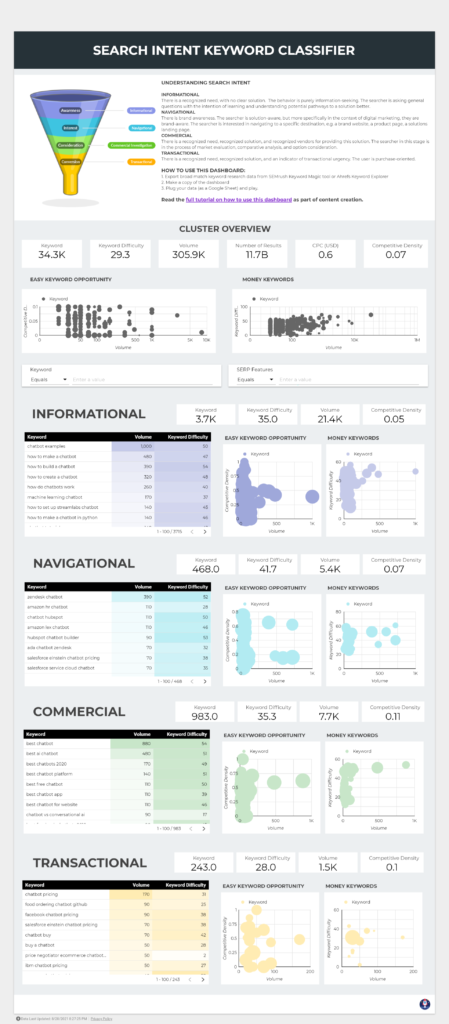
Although the template looks beautiful, I think what is more worth learning is the part that classifies search intent and analyzes it. If you are not familiar with Data Studio, I highly recommend copying it for practice.
link:template / introductory article
[Tip] Use Screaming Frog to crawl GSC web pages
When performing a health check on a website, there are two situations that are easily overlooked: (1.)Orphan pages exposed in search results- Because ordinary crawlers will not find them, but they exist somewhere on the website and are seen by users; (2.)does not have any exposed pages- Because normal crawling will only show that they are "normal" (repost 200, have metadata, have headers...), but they do not bring any organic traffic to the website.
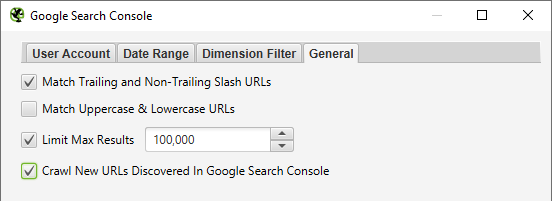
This article teaches you how to use Screaming Frog to connect to the GSC API to find pages with these conditions. There are so many things you can do with Screaming Frog, and I often learn new tricks from others. If you only stay in the default crawling mode, it is easy to lose sight of some details. I recommend that you explore various settings that can be adjusted to enhance your ability to find problems and improve your efficiency.
link:Teaching Articles
[Official Q&A]
Why didn'tsite:access all my web pages?
The question John received in this video was "My website has 130 pages, whysite:domain.comOnly 28 are shown??」
This question should be listed as one of the top 100 most common SEO questions.site:does not mean that the results are complete and should not be used as a debugging method.. If you want to determine how many web pages of your own web page are included, you should use the GSCIndex Coverage Report; If you want to peek at the opponent's website, I personally recommend using third-party tools such as SEMrush, Ahrefs, and Screaming Frog.
[Abstract] Google Search Podcast – How Google conducts search testing
The special guest in this episode is Aurora, who talks about the advertising profit policies of websites and content, because most of them areAd Sense, Ad Mob, Ad Manageris a very politically correct discussion, so those who are interested can listen to it or read the verbatim version~
The more interesting section is when Gary discusses how Google optimizes search results. Don’t expect any secrets in it, but I think everyone might as well pause and think about it: "If you were a member of the Google search team, what indicators and methods would you use to judge whether search results are better for users?」
First of all, the improvement of search results is mainly divided into the improvement of UI or ranking.4,500 improvements in 2020 alone! Almost every proposal will need to go through one or more evaluations.The so-called evaluation may be an external experiment (experiment) or an internal rating (rating), where the difference is that rating is pleasequality rateris used to score, and the experiment is evaluated based on actual user responses, that is, the differences in the appearance of some search results that everyone will see and hear from time to time.
If it is an external experiment, Google will have actual data to represent user responses to the test content. For example, whether users stay longer on the SERP to find suitable results, whether the length of the entire search (session) increases or decreases, etc.
Finally, there will be regular Search Quality Meetings within Google, where a group of senior executives will be gathered to decide whether to finally launch a certain proposal. If you are interested in learning about this search quality meeting, you can take a look at three years agoCNBC interviewand this publicInternal meeting video, quite interesting.
link:verbatim draft
Everyone has heard that Corona Beer’s performance was affected due to its name colliding with the coronavirus. Recently, Delta Airline has also been actively promoting its own products for fear of being entangled with the delta variant virus.Press Releasechanged its name to B.1.617.2 variant XD