This newsletter has three contents that I like very much - the second one is Screaming Frog’s update, which allows users to automatically monitor the SEO of the website with a small budget; the third one is about content pruning, which is a relatively rare optimization direction, and it is quite rare to see how large websites do it; and the fourth one is 103 Early Hints, which is new to me, and it also gives me a good topic with engineers!
- [Official] More information about SERP title rewriting
- [Tools] Screaming Frog v16 update
- [Case] Clear unnecessary pages (Content Pruning)
- [Technology] Cloudflare supports 103 Early Hints
- [Experiment] The SEO impact of adding internal links at the end of the home page
- [Good article] How to prepare an SEO report for company executives
- [Reference] Common web page element templates that do not affect CWVs
- [Reference] Google SERP appearance changes/test records
- [Rumor] Google reaches agreement with TikTok and IG to include short videos
- [Video] Will the theme of the website affect SEO?
[Official] More information about SERP title rewriting
Started in mid-AugustSERP title rewrittencaused a lot of discussion, so Danny Sullivan posted another article on the official blog to provide more information, which said that according to the communityFeedback, they rewritten the SERP title (with<title>tag (different) has been reduced, and the original 80% has been adjusted back to about 87% of the web pages using the original title.
also provides four common reasons why titles are rewritten:1.)Half-empty titles,2.)Obsolete titles,3.)Inaccurate titles,4.)Micro-boilerplate titles.
The official statement is inevitably official. For the situation where the title is rewritten, I personally recommend reading this article.Article written by Dr. Pete, he listed several examples of better, mediocre, and worse titles after they were changed. There is another articleCyrus’s articleis talking about some tips on overcoming the problem of titles being randomly changed. I also recommend reading this to friends who really want to change the title back.
[Tools] Screaming Frog v16 update
My favorite tool, Screaming Frog, recently had a major update, v16! Let me briefly introduce the key points of this update:
- JavaScript functionality further evolved: In the past, screaming frog could only enable JS mode and render JS content, but now there is an additional "JavaScript" category that allows you to 1.) directly compare the content or links that can be seen after JS rendering, 2.) compare the HTML before and after rendering, 3.) choose whether to flatten the shadow DOM and iFrame.
- Data StudioVisualization: Now you can automatically generate a Google Data Studio report from the crawl results with one click. In addition, you can also use the scheduling function to set a fixed crawl every week, which is extremely practical!
- Advanced filtering: Search field now supports regex
Twitter/X Post
View original post on Twitter/X
link:official announcement / [Teaching] How to set up weekly automatic crawling & combine with Data Studio
[Case] Clear unnecessary pages (Content Pruning)
There is an optimization project in SEO called content pruning, which is to delete pages with very low value to make the overall website cleaner, save crawling budget, and reduce the competition between website content. This is usually an operation required by large websites.
I attended a conference a while ago and heard this case analysis. The website deleted 130 million web pages + optimized internal links, and finally had a positive SEO impact. The result is not surprising, but I think this process and ideas, as well as some learnings from it, are very suitable for reference by people who manage large websites!
[Technology] Cloudflare supports 103 Early Hints
Most people should have heard of server status codes starting with 2xx, 3xx, 4xx, and 5xx, but those starting with 1 are relatively rare. It was only after reading this article that I became aware of 103 Early Hints, a new technology that can speed up the website.
The advantage of 103 is that it can save the time for the server to prepare a complete response (response). For example, when the browser sends a web page request (request), it must wait until the server responds before it can see the content in the HTML and request the required resources from the server. And 103 is that after the server receives the request, it directly sends back the resources that will be used by the page, and then completely sends the requested web page back to the client. In this case, the server is basically saying "I need to prepare the webpage you requested, but this CSS and this JS will be used later, so accept them first!」

If your website uses Cloudflare's CDN, even if you have a free account, you can apply to join 103's beta test. In addition, Cloudflare also has many good features that can help the website speed up. I recommend everyone to try it.
link:Mozilla Documentation / Cloudflare articles
[Experiment] The SEO impact of adding internal links at the footer of the homepage
SearchPilot tested increasing the number of links from 30 to 100 in the footer of the home page, and placing more links to other pages on the website. Result: Newly added pages at the footer have a positive impact on both desktop and mobile devices.

This definitely doesn’t mean you should start cramming pages at the end of the page. Like I said before, this type of testing is best viewed with a grain of salt and tested on your own.
I am personally very satisfied with this result, because I discussed with my supervisor at work a while ago whether we should remove some links at the end of the page. Since the current footer of the website is not well designed, and the links feel a bit like they are just for the sake of blocking, the final decision is to keep the current status and not remove it until the design can be optimized or resources are available for testing.
link:SearchPilot articles
[Good article] How to prepare an SEO report for company executives
Tom Critchlow is a senior SEO senior that I admire very much. he has anewsletter, not talking about SEO skills and concepts, but focusing on how SEO can gain better trust and reputation within the company. Those who have worked in inhouse may be more familiar with this. The indicators that SEO cares about and the indicators that the company leadership cares about are often different, which makes it easy to talk the same thing when reporting. To successfully implement the project, it is inevitable to obtain the support of the leadership.

Tom’s recent article “Your boss cares about reporting more than you do”, I was very impressed after reading it. I will briefly share two key points that struck me, but I would also recommend everyone to read the full article.
Don’t use SEO metrics:SEO reports often contain some numbers that only SEO people can appreciate, such as "Website authority (domain authority)」、「Number of top three keywords」、「Number of keywords appearing in featured snippets"...etc. Focusing on the company's revenue, often a report only contains traffic and revenue, which is quite clear and intuitive.
Don’t differentiate based on web page categories alone: SEO reports commonly use web page types to distinguish, such as "front page」、「Category page」、「product page"...etc., but for senior management, they may be more concerned about the differences between tier 1, tier 2, and tier 3 sellers, the growth of new and old customer groups, and the comparison of market performance in different regions. So pay more attention to how leadership categorizes the company's performance when reporting on it, or sit down with senior executives to have a conversation about what kind of reports they want to see.
[Reference] Common web page element templates that do not affect CWVs
web.dev, which lists common web design components without affectingWeb experience indicators (Core Web Vitals, CWVs) Templates forcases such as infinite scroll, banner notifications, carousels...etc.

Currently web.dev official website"pattern" classificationonly has this article, but there should be more resources of this type in the future. Friends who are doing front-end work can save them as reference, so that the website can have some powerful designs without affecting the user experience.
link:web.dev article
[Reference] Google SERP appearance changes/test records
Digital Engine usually rarely shares the appearance changes or tests made by Google on the SERP because most of these novel changes are temporary, but I have to say that some appearance changes are very interesting and make people want to share them, such asWikipedia is not the first result but has sitelinks "Discussion" carousel slot on、SERP、Search autocomplete field appears People Also Ask question...etc.
Recommended hereBrodie ClarkThis SEO has compiled things on his website. You can follow his Twitter or come to this website occasionally to see new things.

link:Brodie website / How to test Google search
[Rumor] Google reaches agreement with TikTok and IG to include short videos
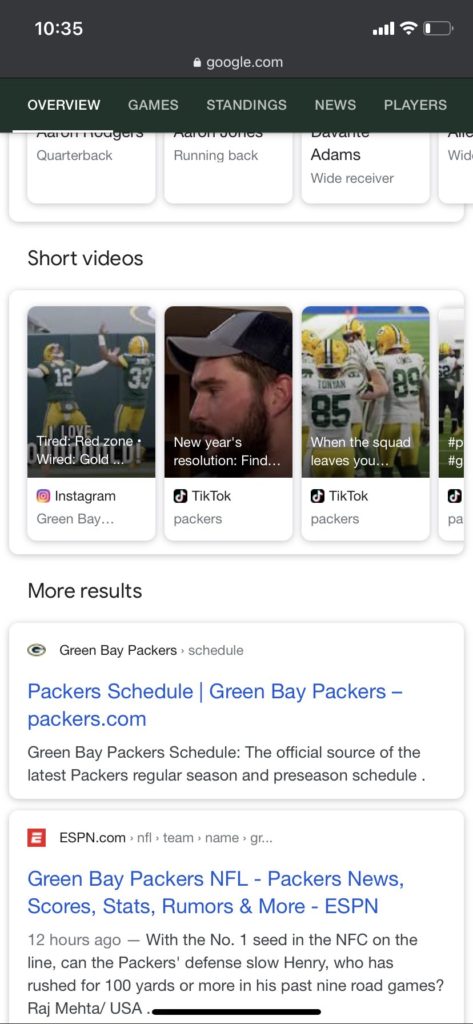
inIssue 24It has been mentioned that the "Short videos" carousel will appear on the search results. It was just a test at the time, but now according to The Information, Google, TikTok and Instagram are reaching an agreement to allow Google to include short videos on these two platforms.
In fact, as long as the video has a public URL that can be crawled, Google can see its content. Therefore, this agreement may be similar to the cooperation between Google and Twitter, allowing Google to see the content on the platform in a more efficient way (for example: API), and may match it with metadata that cannot be seen by the front end, instead of actively sending crawlers to discover, crawl, and understand its content.
link:SEJ report / Google partners with Twitter
[Video] Will the theme of the website affect SEO?
The answer is "yes" - the background theme of the website, in addition to the visual presentation such as color and fonts, also usually affects more technical aspects such as links, website structure, and loading speed.
Therefore, when choosing a theme for a WordPress website, it is not just beautiful, because usually beautiful websites tend to have a lot of complex codes mixed together, resulting in a speed disadvantage. A better method is to build a test website, and then do some SEO analysis to confirm that the new theme does not have too many problems and that the customized areas can be customized, and then implement the new theme to the main website.
There is a Search On event at the end of September, because this time there is no big news like last year (passage retrieval/passage ranking), so I will include it in the next issue and then tell you what I talked about. Friends who are very curious can read this article first.TechCrunch report~
Related reading
Guess.js: Use data to predict the next page and then decide whether to prefetch it
A historical note discussing prefetch, user behavior data and machine learning together. The key point is that prefetching should be based on a balance between probability and cost.