It’s nearing the end of the year, and the SEO circle, like our other industries, will be relatively quiet during this period. This issue introduces two annual reports related to SEO in 2021, and there are also several recommended readings. I suggest that you read the summary I wrote below before deciding whether to read the full text. There is still a lot of good information in the content, although the title may seem a bit watery... The last is "inclusive language", which is a trend in foreign countries in recent years. Although I haven't seen much discussion in the Chinese circle, it is an issue worth starting to pay attention to.
- [News] December Product Review Algorithm Update
- [News] Google Merchant Launches Three New Competitive Exposure Metrics
- [Report] 2021 Local SEO Ranking Factors Survey
- [Report] 2021 Web Almanac Online Yearbook Report
- [Interesting Facts] Google 2021 Search Review
- [Research] Are backlinks still important for SEO?
- [Good article] Why are the positions of VP of SEO almost invisible?
- [Source] AMP Bento: Using AMP modules on non-AMP websites
- [Case] Optimizing e-commerce webpage classification page (6.3s > 2.7s)
- [Abstract] Google Search Podcast – Inclusive Language (Inclusive Language)
[News] December Product Review Algorithm Update
"Product Review Algorithm" inEarly April this yeardebuted with the purpose of combating low-quality industry captions that only put basic or repetitive information with shopping guide links. After more than half a year, Google has made another adjustment to this algorithm, which was launched on December 1, affecting English content, and is expected to be updated within three weeks.
That time in Aprilhas a significant impact, I myself have witnessed ~20% fluctuations in the traffic of several websites. If you manage this review or shopping guide website, you can pay close attention to the recent fluctuations. Two new principles have been added to this announcement:
- Provide evidence of your own actual experience with the product (visual, auditory, etc.) to support your expertise and reinforce the authenticity of your review.
- Putting links to multiple sellers in your reviews gives readers the option to buy from the merchant of their choice.
The second point caused some concern on TwitterDiscussion, because Amazon's terms of use state that reviewers cannot use Amazon's product information (pictures, videos, product descriptions...), but link to non-Amazon websites. In response, Google’s official representativeonly respondsIt is up to the commenter to choose which one to comply with.
Link: Official Announcement (December / April)
[News] Google Merchant Launches Three New Competitive Exposure Metrics
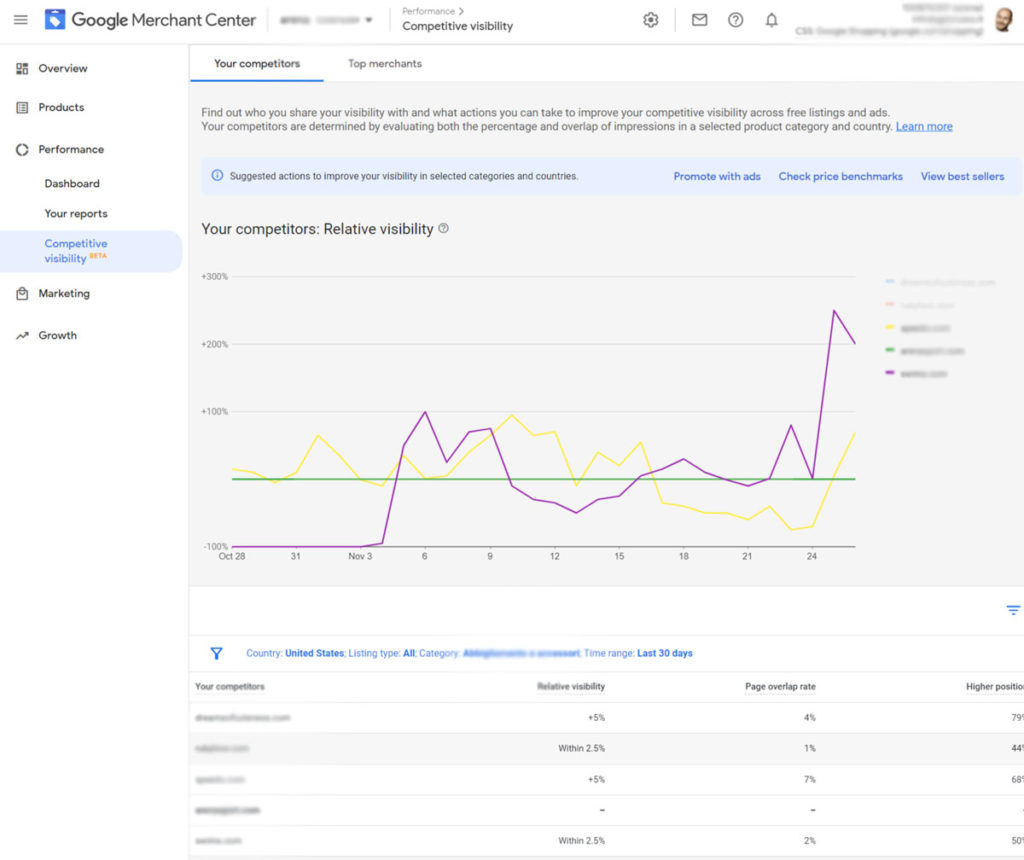
Google Merchant Center allows merchants to set up Google Shopping ads or placeProduct free listingon Google Shopping platform. Recently, a new competitive visibility report was launched on the platform, which contains three very useful indicators.
- Relative visibility- is a competitor product, relative to the percentage of impressions your product has on Google Shopping.
- Page overlap rate- refers to the overlap rate when your products appear on Google Shopping, and the products of competing merchants are also exposed at the same time.
- Sorting lag rate (Higher position rate)- Represents the percentage of your competitor ranking in the front when both you and your competitor have products.
link:official document
[Report] 2021 Local SEO Ranking Factors Survey
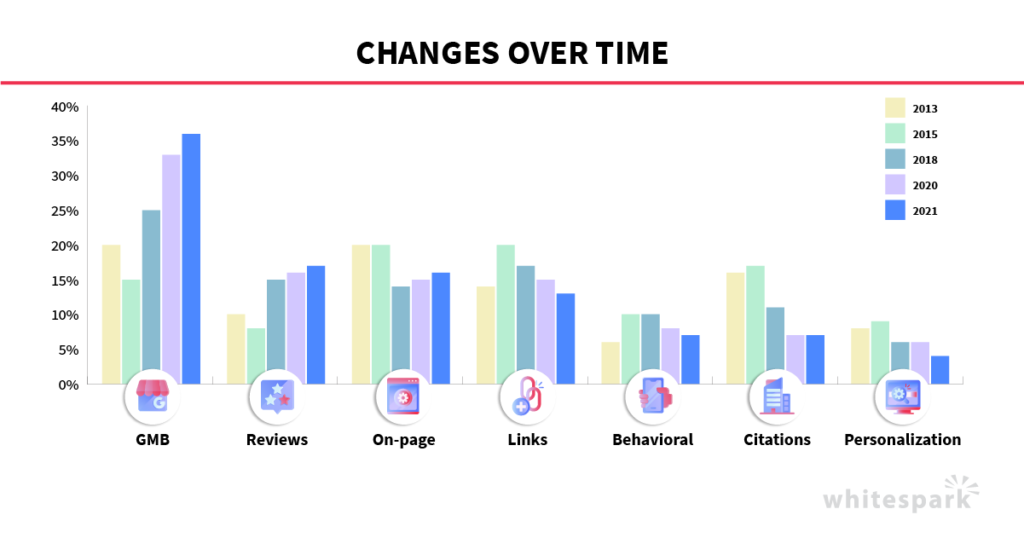
This survey, presented by Whitespark, interviewed Local SEO experts and investigated the importance they believe in 132 possible ranking factors in 2021, in Local Pack/Local Finder and Local Organic Ranking.
「What do experts think are the more important influencing factors now?」「image still important?」、「Is it equally important to ensure NAP (name; address; phone) consistency?"...Wait a minute, if the website you run falls into the category of Local SEO, it is highly recommended to take some time to read this report


link:Local SEO 2021 Report / Local SEO 2020 Report / Matt Cutts talks image EXIF metadata
[Report] 2021 Web Almanac Online Yearbook Report
Compared with the previous annual report, this2021 web almanacis not that easy to digest, with a total of 24 chapters and reports from more than 113 contributors analyzing nearly 820 websites. Here are some interesting numbers that I saw when I scanned them. If you are particularly interested in any chapter, please read it yourself. You are also welcome to leave a message with your findings!
- HTTPS usage- Desktop web page is 84.3% (up 7% YoY), mobile web page is 81.2% (up 8% YoY) ( Pass rate oflink)
- CWV- 41% for desktop pages (34% last year) and 29% for mobile pages (24% last year) (link)
- 71.9% of web pages haveH2, but only 65.4% of web pages have H1 (link)
- Judging from the data in July 2021, 77.4% of websitesMobile trafficis higher than desktop traffic (link)
- Lighthouse data shows that half of the web pages load about 155KBJavaScript is not used, accounting for 36.2% of all loaded JS resources (link)
- Among websites using Content Delivery Network, 75.4% useWordPress, and WP’s market share has also increased by two percentage points compared with last year (link)
- is supported by 82% of the top 1000 websitesHTTP/2 (link)
link:2020 Web Almanac Online Yearbook Brief
[Interesting Facts] Google 2021 Search Review
Everyone should know that Google will publish a search review of the year at this time every year to see the most searched words in different categories in different countries. Every time I see it, I unknowingly spend some time browsing it, especially if you can filter it into global or specific countries to see what is popular in each country.
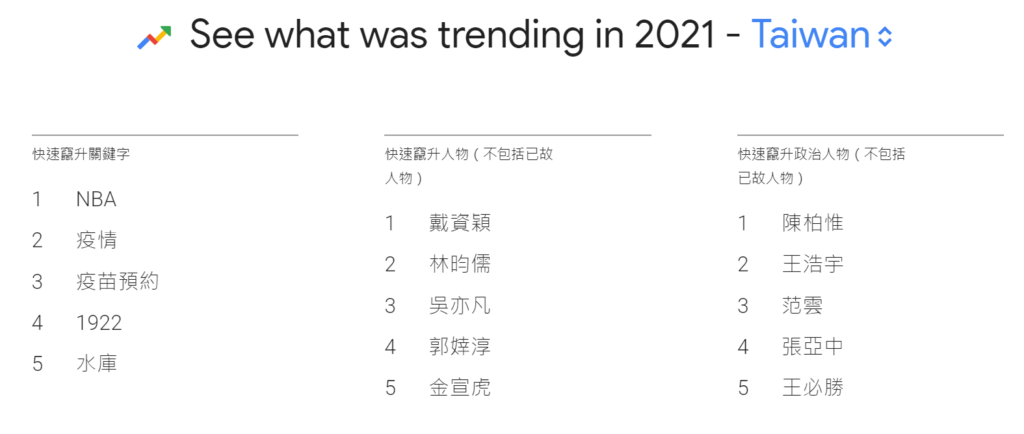
Another thing that few people know is that different countries sometimes have different classifications, for exampleJapanhas two categories: "Game" and "Animation" that are not seen in other countries!
link:2021 search word rankings / 2020 search word rankings
[Research] Are backlinks still important for SEO?
In the SEO circle, you often hear people saying that links are no longer important, so in the spirit of experimentation, Ahrefs did this test to check it out.Backlink Doesstill have any impact on website rankings? The method they used was not to add a large number of backlinks and then observe the rankings (if there was a way to do this, the quality of the links must not be high), but to select three articles and put a total of 3,476 links into the disavow file, asking Google not to count the value of these links.

The conclusion is that links still have a considerable impact on rankings. Another interesting point is that after removing the disavow file, the ranking of the webpage does not necessarily return to the original level. The reason is not sure, but I personally guess that during the period of ranking drop, Google saw that the competing webpage that replaced it could also meet the searcher's intention, so it continued to rank the competing webpage at the top.
[Good article] Why are VP of SEO positions almost invisible?
I mentioned in the previous issues that I really like to read Tom Critchlow’s commercial SEO articles recently. This article is also a favorite of mine. In chats with colleagues, I often hear that people don’t know the next step in their careers (including myself). What position will SEOs take if they continue to go? How to build a skill tree? Although the author shared his work experience in the United States, there should be many places worthy of reference. I recommend everyone to pay attention to his e-newsletter -The SEO MBA!
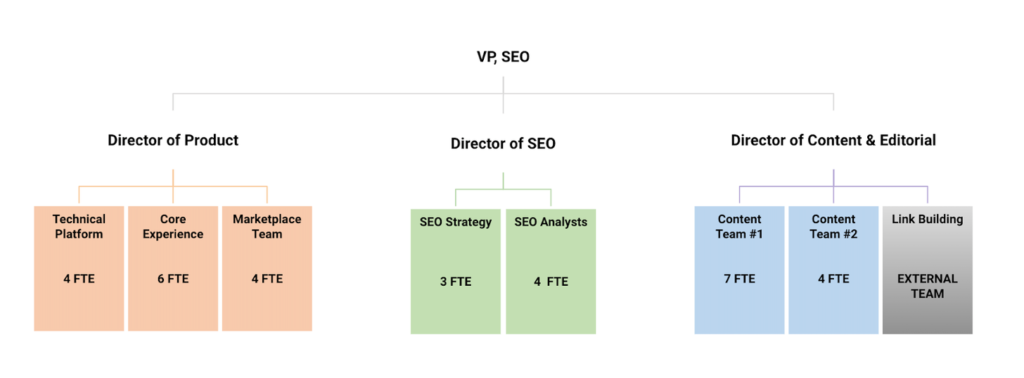
Tom shared that he once helped a company reorganize the SEO team. The team had more than 30 people and was designed to be led by the VP of SEO. However, after recruiting this person, they found that the team was essentially responsible for the entire front-end website experience, so they changed the title to VP of Product. One of the concepts advocated in the article is "leave your SEO tribe" and don't only care about what SEO cares about. For example,
- If you want to go to product in the future- Then you should start to get in touch with web design, conversion rate testing, etc., instead of just caring about the title, description, H1, H2... and so on of the web page.
- If you want to go into marketing in the future- Then you should have a more comprehensive understanding of how a project can help traffic channels other than SEO, or a deeper understanding of the strategic execution methods of PR and brand positioning.
link:Original English text of this article/Introduction to Tom’s past articles -How to advocate for SEO within your company ; How to prepare an SEO report for company executives
[Source] AMP Bento: Using AMP modules on non-AMP sites
The concept of AMP Bento is to make each UI module on the website AMP.Allow non-AMP web pages to use the ready-made AMP module, so that the web page can have a good experience at least for this module.. In other words, if a web page wants to add an image carousel module, developers can go to AMP Bento to find the already developed code and apply it on their own website. It's like a lunch box with different side dishes (modules) in it.
AMP Bento ensures that adding this module to a webpage will bring a good webpage experience (page experience), be suitable for various webpage architectures (framework independence), and ensure that components are independent of each other and do not affect each other (component isolation). For example, the web page simply looks like this:<head>Load the JS and CSS required by bento, and you can<body>used in<bento-fix-text>This font will be adjusted according to the module size of the component.
<!DOCTYPE html>
<html>
<head>
  <script async src="https://cdn.ampproject.org/bento.js"></script>
  <script
    async
    src="https://cdn.ampproject.org/v0/bento-fit-text-1.0.js"
  ></script>
  <link
    rel="stylesheet"
    href="https://cdn.ampproject.org/v0/bento-fit-text-1.0.css"
  />
</head>
<body>
  <bento-fit-text style="max-width: 200px; height: 60px">
    Hello world!
  </bento-fit-text>
</body>
</html>link:Official announcement / AMP Bento unveiled at AMP Conference 2019
[Case] Optimizing e-commerce webpage classification page (6.3s > 2.7s)
There are quite a few cases of this type, but I chose this one because it contains very specific steps to check the project. Even if you are not a front-end engineer, you can understand it as long as you have some concepts. The author selected a category page for a clothing retail website and optimized it based on the problems he saw, shortening the loading time of the LCP from 6.3 seconds to 2.7 seconds. He estimated that this would increase the company's profits by 8 to 12%.
The optimization projects mentioned in the case include the following points. The article has a more detailed description and screenshot explanation. You may wish to cross-compare your own website to see if there is anything that can be quickly optimized.
- The webpage will directly load the image below the initial screen (below the fold), which is nearly 5.5MB.
- Product images will display additional images when the mouse is moved over them. These images will be loaded even though they will not be displayed on mobile phones.
- use
asyncornomoduleAllow non-main JS resources to be delayed or even not loaded to avoid render blocking - Place the LCP file on the main domain and
<head>middlepreload
link:Norse Projects website optimization case
[Abstract] Google Search Podcast – Inclusive Language (Inclusive Language)
Inclusive language is a topic that has become popular in recent years. It basically advocates the use of neutral words when speaking or writing to avoid the inherent stereotypes of language. For example, in inclusive writing you should use fireperson (neutral) rather than fireman (masculine) or firewoman (feminine). When I saw the title of this podcast, to be honest, my immediate reaction was to say, does SEO matter now? But after listening to it, I was very enlightened, because I heard people discussing this topic more and more often in the company or on the Internet.
Although the concept of using neutral words is very simple, there are many difficulties in implementing it in practice. For example, "student" in French is divided intoétudiant (陽性)orétudiante (陰性), neutral words do not exist, so they need to be created and becomeétudiant/eorétudiant·e, and the plural type becomesétudiant/esorétudiant·e·s. Although there is a more common neutral writing style in writing, how to pronounce Google Voice Assistant is also a problem. If we extend this issue to other complex languages, or even inclusivity beyond gender, we can have a little idea of how broad the entire issue is.
John mentioned the challenges that Google will encounter when searching. There are three main stages.(1.)is inindex stageWhen you see neutral words (or any new words) used in the text, you must be able to extract them;(2.)inranking stage, the algorithm must match the search term with its neutral version (or vice versa) when understanding the search term;(3.)Finally, it is on the knowledge graph (knowledge graph), such as "Who is the first lady of the United States?", the original第一夫人is the relationship between two entities (node or entity). This relationship will need to change due to the use of neutral language.
In summary, they encourage everyone to use inclusive language, especially if you/your readers care about it. Google searches will encounter various challenges, such as the ones mentioned above, and for example, when searching for firefighters, all images that come up are male-biased. However, this is a problem that Google needs to solve, and it is not something that content creators need to worry about because of SEO.
link:verbatim draft / United Nations Gender Inclusive Language Guidelines / Google's writing guide - inclusive
The author returned to Taiwan and the quarantine ended after another eight hours (I had to get a haircut as soon as I came out...). From the moment I landed, I could feel the smoothness and perfection of the entire epidemic prevention measures. If there are frontline personnel around you, please say thank you to them on my behalf!!