Happy New Year everyone! This is the first issue of 2022. Since the last issue was suspended, the news since mid-December has been compiled. This issue talks about Local SEO, which is rarely introduced, and has the largest algorithm update in the past five years; Google 2021 major update infographic; Article 6: Although experts’ opinions on SEO operations in 2022 are inevitably cliche, some of the opinions are still worth reading!
- [Review] Google 2021 major update review
- [Update] Local SEO’s largest algorithm update in the past five years
- [Report] 2021 Content Marketing Benchmarks
- [News] Current status update and development of IndexNow
- [Tool] Forwarding record and tracking form
- [Expert opinion] 2022 SEO trend prediction and coping skills
- [Technique] Free of plug-in Google Sheets formula importxml
- [Video] John Mueller answers questions about domain
- [Abstract] Google Search Podcast – The past and future of robots.txt
- [Abstract] Google Search Podcast – Google Search Team 2021 Review
[Review] Google 2021 major update review
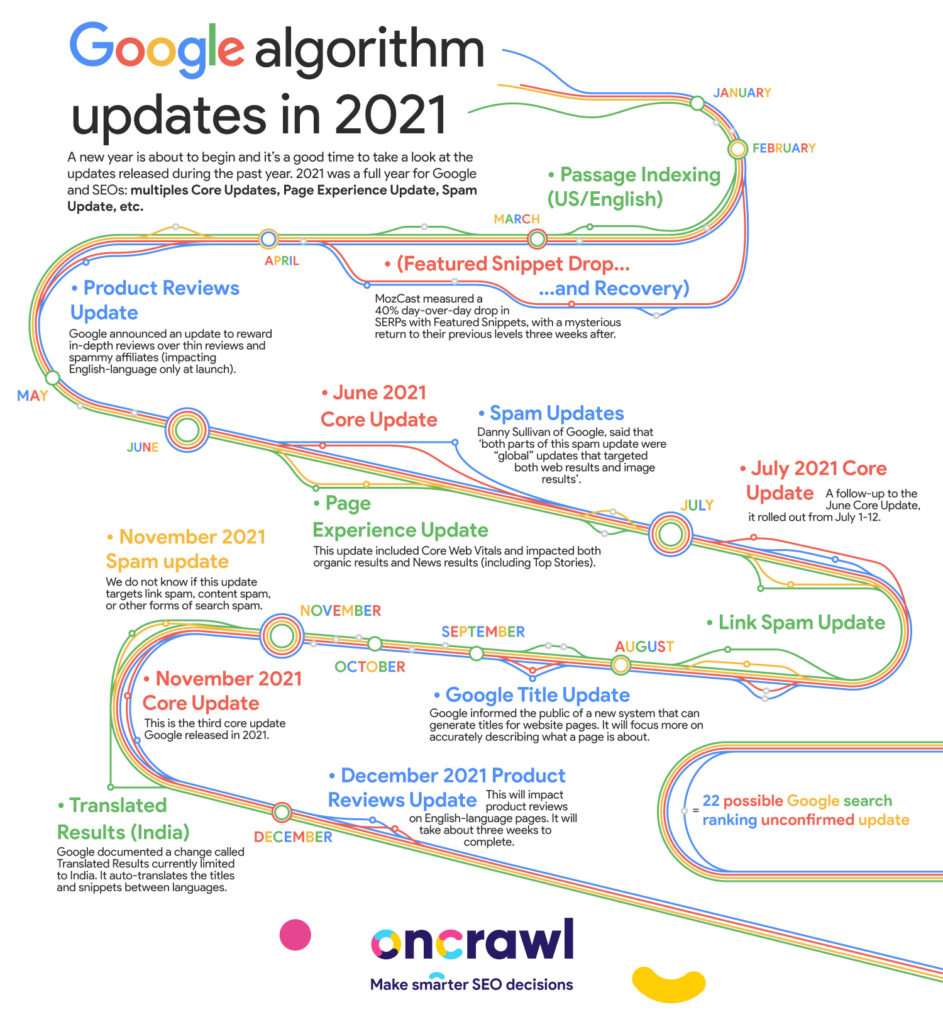
There are more algorithm updates in 2021 than in past years, especially morepassage indexing、product reviews, andspam updates, these substantial adjustments.
SEO company Oncrawl has compiled Google’s important algorithm updates in 2021 into a beautiful infographic. If you have followed SEO or digital engine newsletters in the past, these should be familiar to you. You can click on the image to enlarge it for a review!
[Update] Local SEO’s largest algorithm update in the past five years
Local SEO (Local SEO) has a global algorithm change from 11/30 to 12/8 in 2021. Although Google did not provide more information except announcing this update, according to the analysis of the Local SEO community and experts, this algorithm change is the largest in five years, and the two aspects that have the greatest impact are:(1.) The distance between merchants and searchers affects the increase, and(2.) Keywords in the merchant name。
Twitter/X Post
View original post on Twitter/X
It is worth noting that keywords appear in local business names, although thisviolates Google's guidelines, but it is a generally recognized and effective method in Local SEO. Whether it is still worth continuing to use after this update deserves a re-examination!

link:Official Document - How to optimize local ranking / Joy Hawkins Analysis / BrightLocal Analysis
[Report] 2021 Content Marketing Benchmarks
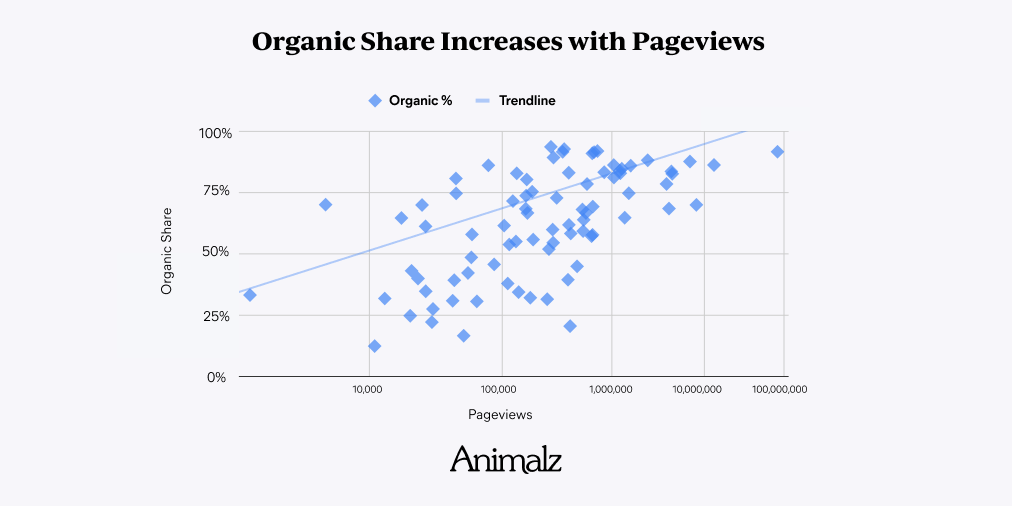
This report was launched by Animalz. This is the third year that they have compiled a similar report, using nearly 100 blogs, more than 60,000 articles, and comparing it with the previous year's numbers to summarize some trends. The article is a bit long, but it is a good resource for inhouse SEOs who are working independently. They can know the performance of other blogs and whether they are above or below the average.
Here are a few key points. I recommend that you read the first half of the takeaways at a young age!
- The natural traffic of small blogs accounts for 44% of the total traffic; the traffic of large blogs accounts for 89%
- The traffic brought by social media to blogs has declined for two consecutive years - 17.12% in 2020; 5.51% in 2021
- For large websites, blog traffic accounts for twice as much as for small websites.
- Email only accounts for 1.1% of the traffic brought to the blog on average.
- Social only accounts for 0.3% of the traffic brought to the blog on average The average median bounce rate for
- is 74.8%
[News] Current status update and development of IndexNow
was introduced in Issue 43, which was developed by Bing and Yandex TheIndexNowopen source protocol, according to Bing's latest official article, is currently used by more than 80,000 websites. It actively notifies search engines through API when web pages are created, modified, or removed. The change information of these web pages only needs to be sent to one search engine, and it will be shared with all search engines that adopt this protocol.
If your website uses Cloudflare or is hosted on WordPress, you can easily enable this feature. Enable in Caching in Cloudflare backendCrawler Hintsfunction, or install IndexNowWordPress plug-inwill do.
Twitter/X Post
View original post on Twitter/X
If you are a practical person and want to find a Python project to practice, you can also refer tothis article's approach.
link:Bing Announcement
[Tool] Forwarding record and tracking form
by foreign netizensJeff Louelladeveloped tools that can track redirects created in the past and see if a website still behaves as expected. In the process of website management, sometimes the past settings are lost over time. With a tool like this, you can continuously track whether all redirects are directed to the target web page, which is especially useful for small and medium-sized websites.

This file is quite simple. Just enter the starting URL in column A and the expected final URL in column B. It will tell you whether the transfer result (column C) is correct, the path of the transfer (column D) and the number of times (column E), the final transfer result (column F), and the top overall information.
link:Article introduction / Tool Link
[Expert opinion] 2022 SEO trend prediction and coping skills
As usual, major SEO companies and experts will launch their own views and strategies on SEO trends at the end of the year and the beginning of the year. Here are 22 techniques compiled by Moz that they think are worth trying in 2022 (bold fonts are the points that made my eyes light up).

22 Smart Google SEO Tips for 2022 — Whiteboard Friday
- A/B testing - through testing rather than intuition
- Author pages - Create EAT
- Google title rewrites - Know whether your title has been rewritten, whether the original title is not good enough or Google misjudged it
- Nuke the "fluff"- Omit the rhetoric part
- FAQ schema - Occupy a larger footprint in the search results industry, put links in answers
- Tabbed content - Confirm whether the content placed after the tabbed page is visible
- Faceted navigation - Know what does or does not need to be crawled and indexed
- Internal link optimization - Check internal links and anchor text
- Deep linking- At the right time, further link to the specified paragraph instead of the page
- High ROI link building- Creating assets that earn links and estimating the cost of creating them
- Reduce redirects - Simple but easily overlooked self-test
- SEO for affiliate links - Google has begun to launch some guides for affiliate websites this year. Those who operate this type of website should pay close attention to Google’s trends.
- Reputation research - Quality Guidetalks about how raters evaluate the reputation of a website/creator, so SEOs should also pay attention to online reputation.
- Core Web Vitals — minimums - CWVs may not have such a heavy impact on SEO, but don’t fail all three
- Ditch AMP? - If AMP is a big technical burden, you can consider abandoning this project
- Google Discover - Start thinking about how to make your content appear on Google Discover
- Local SEO GBP categories - Confirm whether your business profile has the most suitable business category selected
- Favicon review- A fairly simple way to determine if your favicon will stand out better on mobile searches
- Learn GA4- Trends in website analysis, hurry up and get familiar with the new version of GA
- Attend virtual conferences - Due to the epidemic, there are only online forums, but they are relatively cheaper.
- Charge more - See other people'sSEO charging standards, maybe consider increasing the pricing
- Be the last click- Try to satisfy users' search intent as they enter the site
link:Moz / WordLift (technical) / iPullRank (includes other SEO opinions) / Barry Adams (Google News)
[Trick] Google Sheets formula without plug-inimportxml
importxmlis a very practical built-in formula on Google Sheets. It can be used to capture HTML information on a web page. Readers who have never used it are recommended to enter it in the browser bar.sheet.new, open a file and give it a try!
Twitter/X Post
View original post on Twitter/X The
formula requires the input of two parameters. The former is the URL and the latter is xpath (representing the object you want to capture). Here are a few examples:
- =IMPORTXML("https://www.example.com","//title")
- =IMPORTXML("https://www.example.com","//meta[@name='description']/@content")
- =IMPORTXML("https://www.example.com","//h1/text()")
- =IMPORTXML("https://www.example.com","//link[@rel='canonical']/@href")
[Video] John Mueller answers questions about domain
In this video, John answers various questions about domains and explains the impact of different domain settings on SEO. I feel that the concept of domain is a common technical issue for many newbies who are new to SEO. I plan to write an article about it in the future, so if you have other questions about domain, please leave a message or send me a private message first! The following is John's answer in this video.
.comand
Does.spaceor other "generic top-level domains (gTLD)" have any impact on SEO?
makes no difference to Google
wwwandnon-wwwAre there any SEO differences on the website?
There is no difference for Google, but whether to add www may make a difference in the website structure. (It is generally recommended to use www, especially when deciding whether to share cookies between different properties. It is easier to set up.) Can
canonical tag connect different top level domains?
Yes, even country code top-level domains (ccTLDs) and general domains (gTLDs) are acceptable.
Can country-specific top-level domains (ccTLDs) be ranked in other countries?
Yes,
The domain.decan also be ranked in other countries. But there is a difference in SEO. ccTLD cannot be listed in Google Search Console.settingsis a website for a certain country.
[Abstract] Google Search Podcast – The past and future of robots.txt
This episode of the podcast features David Price, who is responsible for legal and compliance matters related to Google search. In this episode, they discuss the origin and future of robots.txt. The rhythm of the discussion is very..."legal", such as what is a crawler? What kind of crawlers should comply with the restrictions of robots.txt? In addition to search engine crawlers, should the testing tools in GSC comply? Or should social media crawlers comply? (As an aside, Google+ does not comply with the robots.txt specification)...and so on.
Gary said something very interesting. Technically speaking, he dislikes the word crawler, because literally crawler seems to mean that Googlebot will follow the links and crawl all the way down. But in fact, Googlebot only fetches the content of a web page, and discovering new links is done by another system.
also mentioned that robots.txt has almost remained unchanged since its inception. Unlike most Internet protocols (such as HTTP upgraded from 0.9 to now 3), in the early years Google actually thought about upgrading its functions so that it could not only limit crawling but also indexing functions. That is to say, you may have heard that there was an early robots.txtnoindexinstruction, this proposal mainly allows disallowed web pages to still be indexed by Google, but it was later canceled due to various reasons.
link:verbatim draft
[Abstract] Google Search Podcast – Google Search Team 2021 Review
This podcast episode mainly focuses on John, Gary, and Martin reviewing the content and bottlenecks of their work in 2021. The amount of information in this issue is not too large, so you can easily listen to it if you have time.
Martin is mainly responsible for developer relations, especially the relationship between JavaScript and SEO. He believes that SEO personnel are now more and more familiar with JavaScript websites, and many of the rejections of JS have been clarified. Moreover, the SEO problems encountered by most JS websites are actually general SEO problems. They only appear more frequently on JS websites and are not the fault of JS itself. But that doesn’t mean that Google is perfect when it comes to including JS websites. For example, the Google rendering serviceJS multi-threading (Multithreading JavaScript) processing There is still a lot of room for improvement on, and Martin also expects this to be an increasingly popular topic in the future.
Gary talked about the core algorithm changes. There is actually no consensus within Google on whether to share the algorithm changes with SEOs. Gary said that although Google knew what had been changed internally, it would not make these changes public, so it became "will tell the outside world that there are changes to the core algorithm, and when they will start and end. But it cannot give any more specific advice other than following the search guidelines and focusing on the user."Such a situation, he personally doesn't think it makes much sense. In addition, rather than thinking of the search algorithm as a punishment for websites with lower rankings, it should actually be seen as a reward for websites that improve their rankings.
The author recently returned to the United States and needs some time to settle down and deal with some chores. Changes to the membership system will be released before the end of January, please wait for me!