The content of this issue is well-balanced, with new knowledge, news, soft articles, and tool introductions. I highly recommend that you spend more time on the second point of the seemingly stereotyped "Google is dead?" discussion thread, and try to think about whether your SEO strategy can still remain competitive in the search ecosystem in a few years. In addition, the fifth point of BigQuery is free and practical, and it is highly recommended to spend some time to learn this tool!
- [News] "Web experience update" officially launched on desktop version
- [Discussion] Is Google dead?
- [Intelligence] Google Pirate Update review
- [Good article] The reasons and details of the disappearance of Favicon
- [Teaching] GSC + BigQuery + Data Studio
- [Presentation] SEO Competitor Analysis
- [Tool] Google Trends enhanced plug-in
- [Video] Content removed following EU right to be forgotten request
- [Video] Does website server location affect SEO?
- [Abstract] Google Search Podcast – Aleyda Solis Story
[News] "Web experience update" officially launched on desktop version
Web experience (Core Web Vitals)The update will be officially launched in February 2022 and will affect desktop search (desktop, laptop, tablet) rankings. It is expected to be fully released by the end of March.
Web page experience combines three aspects of quantified web page experienceCore Web Vitalsincluded in the calculation of rankings, inLaunched last yearAt that time, it only affected the search results of mobile phone boards, and it took nearly two and a half months to be fully implemented. Although the extent of the impact is still unknown, based on the experience of mobile phone boards, the impact will not be too great. If you have concerns, webmasters can nowSee how the website performs on the desktop board on GSC。

link:Two new web experience metrics / Official Q&A on Core Experience Indicators / [Tool] Compare core experience indicators of SERP competing websites
[Discussion] Is Google dead?
Discussions about Google being in decline or Google being dead appear every once in a while, and there was another article recently:Google Search Is Dying",existReddit,Hacker News,andTwitterAll major communities are fermenting, and Google search spokesperson Danny Sullivan is also actively discussing with everyone in various discussion threads.
The article mainly says that many people will add reddit after the search word (for example, search "best home office chair reddit"rather than"best home office chair"), specifying that you want to see results on reddit (one of the largest forums in the world), or results from forums such as stack overflow and hacker news, and do not trust the natural ranking given by Google.
This is indeed something that no matter whether you are an SEO or an ordinary user, you will feel it. Advertising aside, most Google search results for product recommendations are occupied by marketing articles. However, users are becoming more and more numb to these articles and prefer more "real" discussion of opinions such as comments and forums.
This point has been discussed many times in e-newsletters in the past. Traces of machine-produced content can be seen everywhere in English. Many of theseWebsite traffic performancePretty good, but this trend has led toHomogenization of search。Although machine-produced or SEO-oriented articles are relatively complete in terms of keyword placement and layout compared to forum discussion threads, and the Google search algorithm does not accidentally rank them at the top, they have gradually lost the trust of users.Regardless of whether Google can rely on EAT in the future orProduct Review AlgorithmTo change this situation, I think marketers should take a step back and examine the purpose of creating content. I highly recommend everyone to read these discussion threads!

[Intelligence] Google Pirate Update review
In 2012, GoogleannouncementAn algorithm used to punish websites that plagiarize content. The algorithm does not have an official name, but the SEO community often refers to it as "Pirate Update" (I guess it may be to be consistent with Panda and Penguin launched at the same time, both starting with "P").
This algorithm mainly targets web pages with a large number of web pages that violate intellectual property rights. However, it was rarely discussed after the announcement until a recent report provided by Google to the U.S. Intellectual Property Office.file More information was revealed in. The more interesting points include -
- Remove terms related to intellectual property violations in search autocomplete or related terms
- If a website receives a large number of "removal requests", the algorithm will demote it
- It is also difficult to escape punishment by redirecting the punished domain to a new domain
- Specially strengthens infringement of still-in-theaters or prerelease works
- Websites that have been demoted will have an average traffic drop of 89%.

link:Request Google Content Removal Tool / SER Report / [Video] Remove illegal content from Google
[Good article] The reasons and details of the disappearance of Favicon
A good article written by Glenn Gabe. I thought it was nothing after reading the title, but after reading it I found that I had silently absorbed some little knowledge about favicon! Favicon refers to the website logo seen on the search results. It is generally presented in this way in the source code.<link rel="shortcut icon" href="/path/to/favicon.ico">, if the favicon provided by the website fails, Google will provide a normal icon on the SERP.
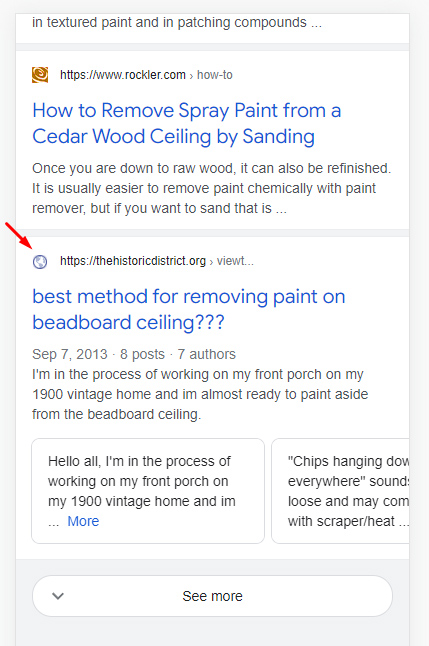
- Although some SEO staff believe that the disappearance of favicon is related to the quality of the website, he does not think so. The author said that in every situation he has encountered, there is a definite technical reason every time, unless the favicon is an obviously pornographic or easily arousing symbol of hatred.
- The favicon file must be at least 48*48, or a multiple thereof (96*96, 144*144...etc), and cannot be smaller than 48*48 (such as 16*16), nor can it be a non-integer multiple (such as 50*50). If the file is svg, it is not subject to this restriction.
- favicon must be square. If the length and width are inconsistent, the illustration may be deformed or not used.
- Google actually has oneSpecial crawler for favicon, will ignore the limitations of robots.txt, but this spider will only come in handy at certain times. Generally, when crawling favicon, Google still uses ordinary spiders, so robots.txt cannot block the path of favicon and home page.
- As more and more people now like to switch to night reading mode, the website can actually provide favicons suitable for night mode to cater to different interface themes!

link:Original English text / Google’s Favicon documentation / Design day/night favicon
[Teaching] GSC + BigQuery + Data Studio
Google Search Console and Data Studio have been introduced many times, and there should be no need to introduce them in particular. The combination of the two can easily visualize GSC data, such as the one introduced in Issue 39Search Intent Analysis Template. However, a very common problem will be encountered in practical applications, that is, when the amount of data is huge, the processing speed will be significantly slower. Sometimes, changing the date or adding a filter will take several seconds to load.
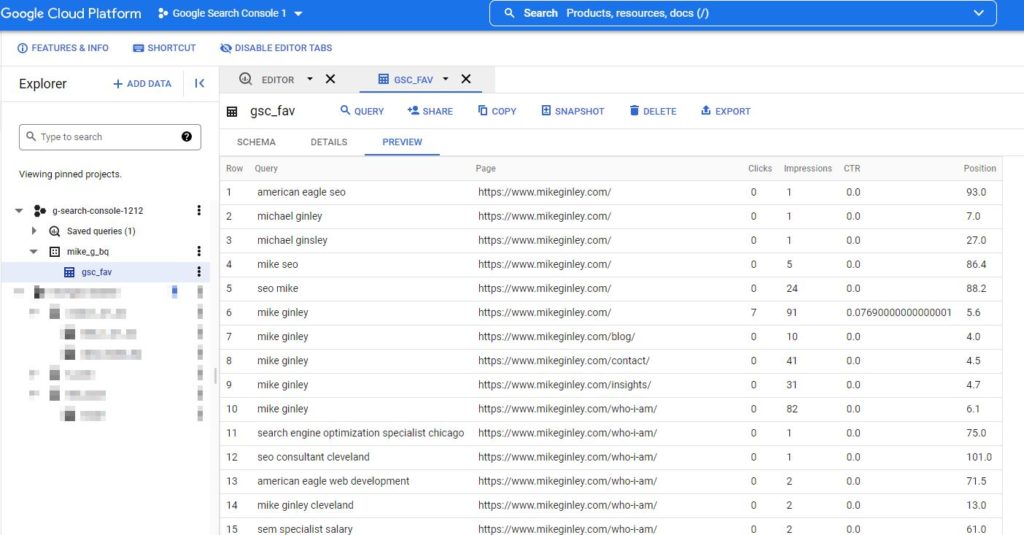
BigQuery comes in handy at this time. Store GSC data in BigQuery*, and then connect Data Studio to BiqQuery (rather than to GSC). There are two benefits to doing this: (1.) Data Studio's processing speed will be greatly improved, and (2.) By repeating this process regularly, you can bypass the 16-month limit of GSC data storage.
*This article shows how to use two Google Sheets plug-ins -Search Analytics for Sheets & OWOX BI BigQuery Reports, you can easily complete this step. If you haven’t tried BigQuery yet, I highly recommend you to give it a try!
[Presentation] SEO competitor analysis
A brief but direct briefing on several principles of Gap Analysis for SEO. The first step is to identify competitors - this can be from a business perspective, selecting competitors whose products or services compete with each other, or from a search perspective, selecting websites with highly repetitive keyword themes. After selecting a comparison website, the second step is to analyze the advantages/disadvantages of the opponent website from three aspects: content, brand, and website technology.
In addition to the briefing, the author Lidia also provides two template examples, one isHow to choose competing websites, the other one isHow to analyze competing product websites, although it is not particularly in-depth, the overall direction and analysis structure are worthy of reference.
[Tool] Google Trends enhanced plug-in
This Chrome plug-in is quite good. It adds a layer of Google search data to the Google Trends interface, including search volume, People Also Searched, related searches, related topics, CPC... etc.In particular, the superposition of search volume and search trends allows users to see no longer just the original relative index of 1 to 100, but a more complete concept.
The disadvantage is that this is not a completely free tool. The free version only has a quota of 20 times per month, and the paid version is a bit expensive at $49 per month.

link:Plug-in download / Official website
[Video] Content removed following EU right to be forgotten request
"Right to be Forgotten" is an online privacy policy adopted by the European Union in 2014, which allows individuals to request search engines to remove their data. Although individuals in EU countries mainly have this right, as the world becomes more and more privacy-focused, some non-EU countries have also begun to adopt this concept and legislate, including Argentina, the Philippines, Turkey, etc.As far as I know, there is no similar law in Taiwan, but I still recommend everyone to understand this concept.
Once a request is received, the decision to remove the page is based on five factors - inaccurate, inadequate, irrelevant, excessive, and whether it is in the public interest to keep the page in search results.The so-called "removal" means that a certain web page does not appear in the search results for a certain word (usually the applicant's name), but the web page may appear on other search words. In addition, the webpage will only be removed in regions protected by this law, and the webpage will still be seen in Google searches in other countries.
link:Provisions related to the right to be forgotten / Request Google Content Removal Tool
[Video] Does website server location affect SEO?
The problem with this episode is "Will moving the location of a website server from one country to another affect SEO?”, John replied, whenever Google sees a server change and does not know the location of the server, Googlebot’s crawling speed will automatically slow down to ensure that the new server can withstand Google’s crawling frequency (slow start).
If the server location is close to the user, it may improve the speed and website experience, thereby affecting Google rankings. Webmasters can also use services such as Content Delivery Network to keep the server as close to the user as possible. Finally, server location has nothing to do with Geo-Targeting. If a website wants to target a certain country, it can provide Google signals through settings in GSC or by using a domain with country attributes (ccTLD).
[Abstract] Google Search Podcast – Aleyda Solis Story
This episode of podcast is different from the previous format of three people discussing specific topics. Aleyda Solis, a well-known figure in the SEO field, was invited to talk about her process of becoming an SEO and her contribution in this field. Aleyda is quite active in the SEO circle, and Digital Engine has mentioned the information she shared many times in the past, including herSEO decision flow chart、SEO Study Guide、Data Studio template to analyze whether a website is affected by core algorithms...etc.
Aleyda grew up in Nicaragua when she was a child. The first search engine she came into contact with was AltaVista (later bought by Yahoo!). She worked as a website engineer, and later switched to an SEO consultant and began to take on projects remotely. major works, exceptown website In addition to, there are some helpful matchmakers for remote workremoters.net, SEO novice learning resourceslearningseo.com, and#SEOFOMOWeekly newsletter.
recommends that people who have free time can listen to her story or follow her on TwitterFollow her!
link:verbatim draft
Everyone must be paying attention to the recent war. Especially those of us who are SEOs need to be more capable of reading media and distinguishing true and false information. I hope it all ends soon.