
Google’s core algorithm update and three major UX indicators (core web vitals) are the two biggest news in this issue, especially the latter. There has been a lot of discussion in foreign communities, and the company I work for has also listed them as KPIs for website performance (web performance). In addition, Google's Question Hub program and some SEO anecdotes are also worth reading. The following is the content of this issue:
- Google "May 2020" core algorithm update
- Three pillars of web UX indicators – LCP / FID / CLS
- Chrome plug-in for calculating Web vitals
- WebPageTest supports Web Vitals
- CrUX Report LogWeb Vitals
- LinkedIn entire website disappears from Google search
- Fun Fact: Britney Spears and Google’s spelling correction system
- Google’s Question Hub Project
- Bing launches Bing News PubHub
- Template: Analyze website affected by core algorithm changes
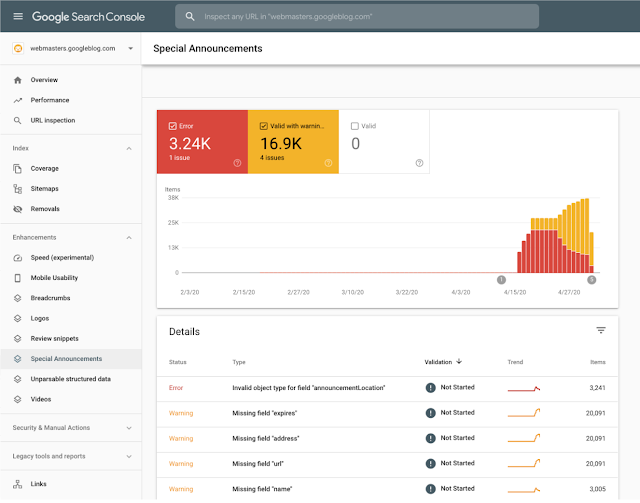
- Chrome will start blocking ads that consume too many resources SpecialAnnouncement report for
- GSC
- Official Video: Website Security Issues
- [Promotion] MDPA Marketing Data Professional Association & NEX Foundation
Google "May 2020" core algorithm update
On May 4th, Google launched the second core algorithm update this year, codenamed "May 2020 Core Update". The impact of this wave of updates was quite severe. One of the websites I manage lost nearly 25% of its traffic.
Twitter/X Post
View original post on Twitter/X
"What exactly has been changed in the core algorithm?" The answer to this question will not be made public by Google. SEOs can only sort out the context by analyzing cases, but they must also maintain a spirit of skepticism. Any statement that is too certain will only appear ignorant. Listed below are two good analyzes that the author has seen, as well as Google’s articles telling webmasters how to view core algorithm changes.
link:Glenn Gabe Analysis / Marie Haynes Analysis / Google: About the core algorithm update
Three pillars of web UX indicators - LCP / FID / CLS
The user experience of web pages has always been difficult to quantify. The Chrome department hopes to solve this pain point, selects three core indicators, and sets standards for each indicator, hoping to systematize UX measurement indicators. These three indicators are:
- Largest Contentful Paint (LCP): Measures website speed
- First Input Delay (FID): Measures website interactivity
- Cumulative Layout Shift (CLS): Measures the visual stability of web page components
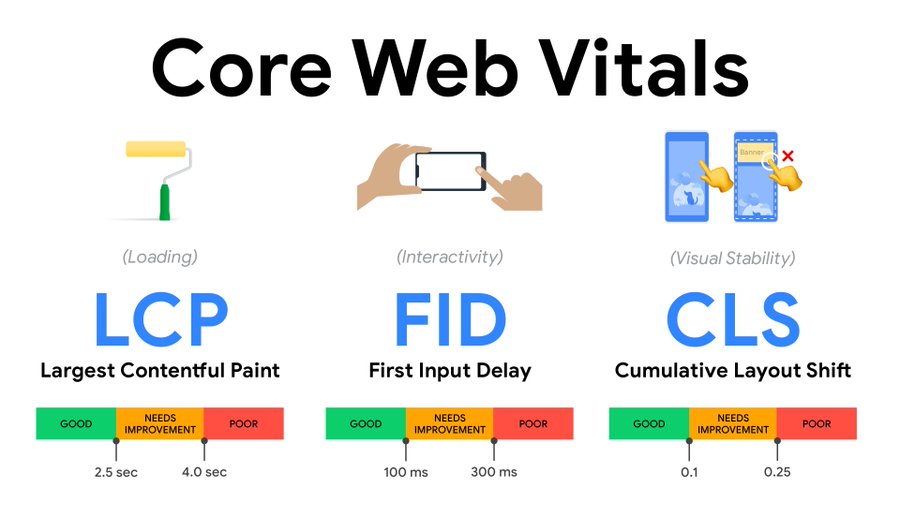
The standard proposed by Chrome cannot be underestimated. Many tools have responded and will start to use these three indicators as the axis, including PageSpeed Insights, WebPageTest, CrUX, Lighthouse... etc., etc. have announced that they will start to support it in the near future, which will be introduced below.
link:Chromium Article / web.dev article / amp.dev article / (Chinese) iThome report
Chrome plug-in for calculating Web vitals
Install this Chrome plug-in to automatically calculate the LCP, FID, and CLS scores of web pages while browsing. This plug-in is not yet available in Chrome's plug-in store. You need to install it through the following methods:
- Download ZIP file
- is obtained after decompression and contraction
web-vitals-extension-masterfolder Enter - in Chrome’s address bar
chrome://extensions - Turn on the developer mode in the upper right corner (Enable Developer Mode)
- will
web-vitals-extension-masterDrag Chrome to the folder and install it
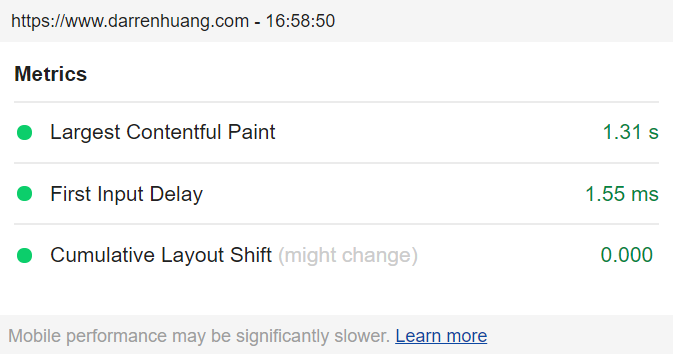
link:GitHub Page
WebPageTest supports Web Vitals
WebPageTest is a very useful tool when testing web page speed. This tool now uses Web Vitals as an important indicator in the report. It will also show the LCP determined by Chrome in the frame-by-frame video of the page loading, and frame it with a red line.
Twitter/X Post
View original post on Twitter/X
Note: FID cannot be calculated through test tools because the tools do not "interact" with the web page, so when using Lab Data, Total Blocking Time (TBT) is usually used instead. TBT is another metric (web vital), but it is not the core metric (web core vital) defined by the Chrome Team.
link:WebPageTest tool
CrUX Report LogWeb Vitals
Chrome User Experience (CrUX) is a public database that records the web performance of Chrome users when browsing the web. Compared with Lab Data of general measurement tools, CrUX data is Field Data and is quite precious. This public information has also begun to record three web core vitals, which can be run using Google BigQuery. The following are the results of the 104 Labor Bank website.

The above data can be interpreted as: 92.08% of users have good LCP loading time (<2500ms) when browsing the 104 Human Bank website (www.104.com.tw), 4.97% have normal (>=2500ms, <4000ms), 2.91% is bad (>=4000ms), where the 75th percentile LCP is 1400ms.
link:Query that produces the results in the above picture
LinkedIn entire website disappears from Google search
On May 6, the entire website www.linkedin.com disappeared from Google, and nearly 200 million web pages and icons on the Knowledge Panel disappeared.
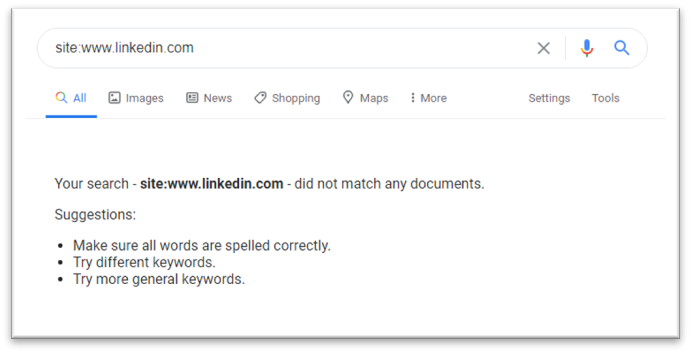
John Mueller later tweeted: "Using the removal tool in GSC to remove the "http://" version will remove all variants (http/https/www/non-www)." Although he did not name the link, the tragedy of Linkedin was probably caused by GSC's removal tool.
Twitter/X Post
View original post on Twitter/X
link:GSC URL Removal Tool
Fun Fact: Britney Spears and Google’s spelling correction system
Google will detect the words entered by the user and determine whether there are spelling errors. But did you know that Google has a public file listing the various spelling errors their correction system has seen, using Britney Spears’ name as an example?

link:Google File
Google’s Question Hub project
Google has a Question Hub project that collects questions that users have not found satisfactory answers to on Google and organizes them in one place so that online media can see them and create appropriate content. This is a very useful tool that allows content producers to see unanswered questions on the Internet, and from real people!
This project was launched in India last year and is still in Beta testing. Recently, there are signs of preparation for launch in the United States. The author is in the United States and when searching on Google, I am often asked under the SERP whether my question has been answered, and if not, what is my question.
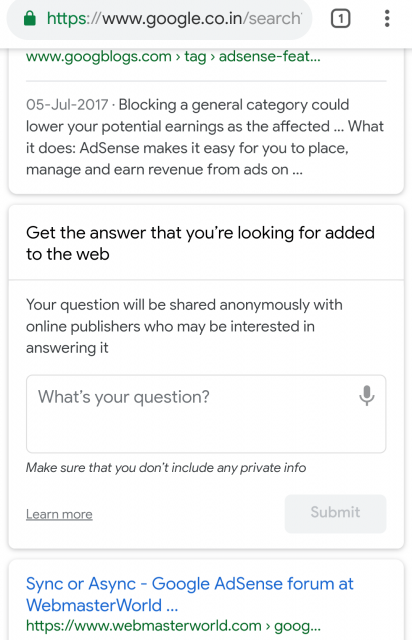
This is a project worthy of attention. Search Engine Rountable has more images provided by Indian users.
link:Google Question Hub/ SER report (1, 2, 3, 4)
Bing launches Bing News PubHub
Bing has launched a free platform - "Bing News PubHub", allowing news media to actively submit content, so that the content has the opportunity to be seen by millions of users when using Microsoft products (Cortana, Outlook, Bing.com & app).

Template: Analyze website affected by core algorithm changes
Foreign netizen Aleyda Solis shared a Google Data Studio template, which can use GSC data to analyze which parts of the website are most affected by core algorithm changes. After copying and stringing it with your own GSC data, you can use it, which is very convenient!

link:template introduction / template link
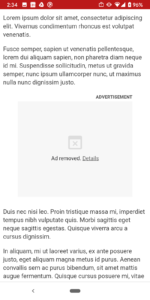
Chrome will start blocking ads that consume too many resources
In order to prevent ads on websites from consuming too much of users’ network traffic and battery, Chrome will begin to actively block such bad ads.
link:official announcement SpecialAnnouncement report for
Official Video: Website Security Issues
In these two videos, Google's Daniel Waisberg and Aurora Morales teach you: common hacking techniques, how to interpret security problem reports in GSC, and how to fix hacking problems.
link:Google Security Report / Transparency Report
[Promotion] MDPA Marketing Data Professional Association & NEX Foundation
These two non-profit organizations that the author has joined have started to get on track recently - MDPA has established a Facebook fan page, and the website has been relaunched with four new articles (one of which was written by me!), and there will be more and more analytical information in the future. NEX’s official blog is online, and the latest article is written by Vivi (also a NEX volunteer) who became famous due to the Tedros Tedros video incident a while ago. In addition to stories about the experiences of Taiwanese people overseas, lectures are also often held.
Both organizations are non-profit organizations and are not oriented towards making money. They will only have a lot of practical articles. Many members are god-level figures. Here is a brief introduction to these two organizations. Everyone is welcome to pay attention!
MDPA Marketing Data Professional Association (Marketing Data Professionals Association), promotes the development, application and management of Taiwan's marketing data industry, builds industry consensus and promotes industry, cross-field and overseas exchanges. >>Facebook fan page / Facebook Group / official website
NEX Foundation (Taiwan Future Foundation), assisting overseas talents in their career development on the international stage. It will further serve as a bridge to connect Taiwanese talents active around the world.Facebook fan page / Facebook Group / official website / official blog
completed this compilation on the weekend and birthday. If you want to make a wish for readers, please leave a message or ask questions!
Related reading
FID to INP: Historical conversion of interactive response speed metrics
Save the 2023 record Core Web Vitals indicator conversion instructions, from user interaction to the next screen drawing, to understand the experience issues that INP wants to measure.
Core Web Vitals official Q&A: historical notes on scores, information and rankings
Save the official Q&A compiled before the launch of Core Web Vitals in 2021, focusing on the data calculation methods and ranking impact boundaries of LCP, FID, and CLS.