In this issue, I think the most noteworthy thing is the cross-language ranking on the fourth point SERP. It will not have any obvious impact in the short term, but it is suitable to reflect on what SEO will look like after 3 to 5 years. In addition, I recommend an "index" article on basic concepts, as well as an SEO workplace survival chicken soup article that I like to read recently. There are also several tool recommendations, and I suggest you practice it!
- [News] PageSpeed Insights interface revised
- [News] Core algorithm changes in November
- [UPDATE] Google Analytics default traffic pipeline grouping changes
- [News] Google Cross-Language Ranking on SERP
- [Good article] The indexing problem of the website and how to improve it
- [Good article] How to advocate SEO within the company and expand the team
- [Tip] Past trend in hours on Google Trends
- [Technique] Use niche market forums to develop content themes
- [Tool] Organize HARO and GPT-3 production titles & descriptions in Google Spreadsheet
- [Tool] Visually chart Google Discover data
[News] PageSpeed Insights interface revised
The interface of Google's PageSpeed Insights tool has been greatly upgraded, but in addition to the UI, the presentation of data is more intuitive and a dedicated Apart from thehttps://pagespeed.web.dev/URL, there are "currently" no changes in functionality. The special emphasis on "currently" is because inintroduced in the previous issue's CDS has several new features regarding website experience, which I believe will also be implemented into PSI's website interface in the future.

PageSpeed Insights has two data sources, and the analysis directions are completely different.CrUXprovides actual user data (Field Data); and uses open source Lighthouse to provide laboratory data (Lab Data). The difference between these two is the most confusing part when you are new to website performance. If you are not familiar with this aspect, welcome to read what I wrote beforeWeb page experience indicatorArticle.
link:official announcement / PageSpeed Insights tool
[News] Core algorithm changes in November
Following thecore algorithm After thechange, Google launched another core change in November. As always, core algorithm changesNodoes not have any official specific optimization suggestions. We can only find out a possible trend by observing the traffic of our own website and reading the analysis of other people in the community.
Twitter/X Post
View original post on Twitter/X
SEMRushandSistrixhas expressed some opinions on the core algorithm through the data of its own platform. Among them, SEMRush mentioned that the ranking changes of the mobile phone board are more drastic than that of the desktop board. In addition, the core algorithm changes this time compared to July are also more volatile. Welcome to these two articles to see detailed analysis of which areas/websites are most affected.
Another interesting point is that mid-November to the end of December is the Thanksgiving + Christmas season in the United States, and the operations of general companies will slow down. Past Googleonce saidtried not to launch major changes during this period, so the launch before Thanksgiving this time surprised everyone, althoughMore than half of the sites did not see a significant impact。
[UPDATE] Google Analytics default traffic pipeline grouping changes
Google Analytics has added eight new categories to the default channel grouping. In addition, I think it is worth noting that both Video and Shopping have been specially pulled out, and each can be divided into organic or paid.

based onofficial flow pipeline classification standard, the classification conditions of Organic Shopping and Organic Video all contain a "When the traffic comes from the shopping/video website in the "list"”, but I searched and couldn’t find this so-called list (Organic search has always been there), if any readers find it, please share it.
[News] Google Cross-Language Ranking on SERP
On the search results (SERP),Google will start to do "cross-language rankings"", for example, when you use Chinese to search for questions about Thailand, if the information does not have many Chinese website results, Google may translate the Thai website into Chinese and use Chinese titles/descriptions on the SERP. After users click in, they will directly see the content automatically translated into Chinese by Google.

You can also use<meta name="robots" content="notranslate">This command exits.
This is actuallyMUM(Multitask Unified Model)In cross-language applications, Google "understands" the meaning of the language, not the language itself.. Therefore, in the future ranking process of matching search terms and web pages, the language of the text may become less and less important. Maybe the technology of machine translation and the application of MUM are not mature enough now, but is it possible that in 3 to 5 years, SEO competitors will no longer be limited to competing websites in the same language?
[Good article] Website indexing issues and how to improve them
In the SEO community, we often see people discussing that the indexing speed of their website is very slow, or that the rate of webpages not being indexed is very high. I think this article written by Tomek Rudzki is worth reading, and I recommend it, especially to people with similar problems.
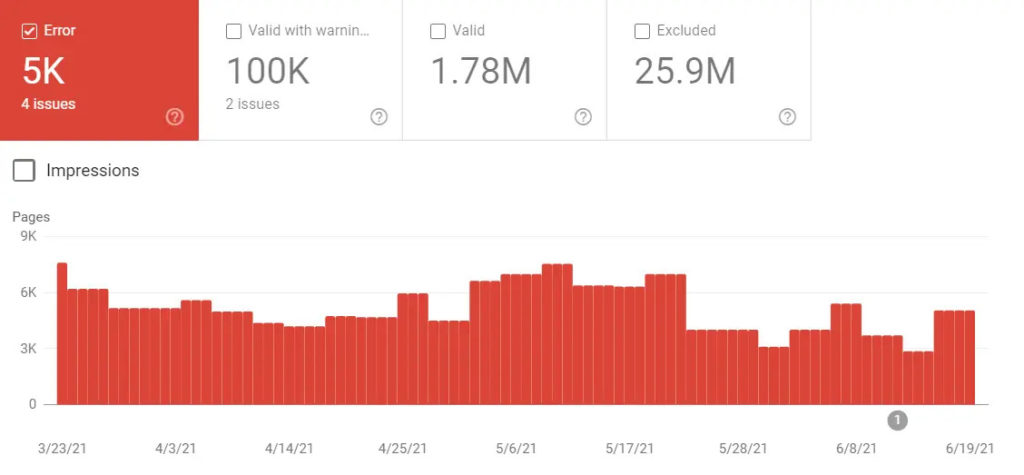
Usually when a website grows to a certain scale, there will be crawl budget and quality problems. You will see in GSC that not all URLs are included. There are three common indexing problems - "Crawled - Not yet indexed」、「Found - not yet indexed」、「Duplicate pages」。
Google's resources are not unlimited in either the retrieval or indexing stages. Therefore, if a website has indexing problems (webpages that should be included are not included), the SEO's job is to carefully diagnose the technical health of the overall website.
link:Tomek Rudzki Index Articles
[Good article] How to advocate SEO within the company and expand the team
Tom Critchlow's article appeared in the e-newsletter for the second time. The things he shared were mainly related to inhouse SEO personnel. In view of his rich practical experience in the past, his content often speaks to my heart.
This article talks about how to obtain resources within the company. SEO will not always just make reports and play the role of an executor. Sooner or later, after becoming senior within the company, you will need to lead a team, and these resources (how many people are needed, budget, cooperation from other teams, etc.) must be fought for by yourself to prove the value of SEO and the resources required to other executives.
Although he prefers business mentality and chicken soup articles, Tom also gave some practices or statements that are worth reference in his suggestions, such as searchsite:linkedin.com/in/ wayfair intitle:SEOTo judge the opponent's SEO team size and resources. I recommend, especially SEO people working in inhouse, to read this article, it is very inspiring to me!
link:Advocating for Expanding Your SEO Team - Tom / Tom’s article introduced in issue 41
[Tip] Hourly past trends on Google Trends
Usually inGoogle Trends, when the selected date exceeds one week, the popularity trend of the word will only be seen in "days". But in fact, you can get past trends in "hours" by adding parameters to the URL.
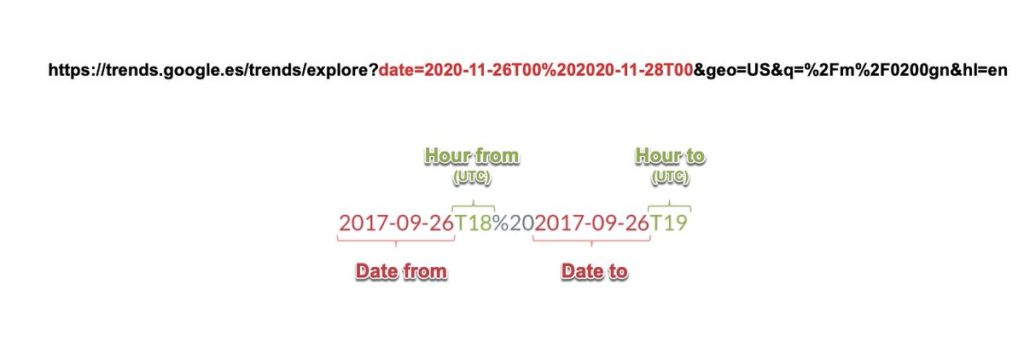
One of the application scenarios is to plan when to publish articles by observing past data during major holidays.
link:Twitter discussion
[Tip] Use niche market forums to come up with content topics
If you run a content website or company blog, I believe you will occasionally get stuck when thinking about topics. Forum websites in the same field will be a good way to discover new topics.
For example, if you are running a pet website, you can first find the relevant forum (ex: www.pets.ca), then throw it into an analysis tool such as Ahrefs, and filter out the ranked words that include question-like words such as why, what, where, how... to see which questions the target audience really has.

There are many ways to come up with content ideas. In addition to discussing your own content, you can also try to analyze your opponent's website, check out forums or Q&A websites in the same industry, or chat with the company's internal customer service department or public relations department. Good ideas will often come out.
link:Original text
[Tool] Organize HARO and GPT-3 production titles & descriptions in Google Spreadsheet
in e-newsletterIssue 34andIssue 39 The Keywords in Sheets website thathas introduced has launched two very powerful Google Sheets tool templates, namely (1.) organizing external link opportunities on HARO in Google spreadsheets, and (2.) using GPT-3 to automatically generate titles and descriptions.
HARO (Help A Reporter Out), there used to beWrite an articlehas introduced it as a platform where you can find PR or external link opportunities. This template will automatically crawl letters sent by HARO, and you can set keywords and time length, and then organize the information in a spreadsheet. The

GPT-3is a machine learning language model, discussed beforeAI production contentalso mentioned that it can produce sentences that are almost invisible to be made by a machine. This template requiresRegistrationis an account of OpenAI (the team behind GPT-3). The free version of the API has usage restrictions. You can use this function about 300 times.hereis the template and account I used for testing. You are welcome to go and try it out according to the method below. If an error message appears, it may mean that the quota has been used up.

=meta("what is seo?")link:Keywords in Sheets website
[Tool] Visually chart Google Discover data
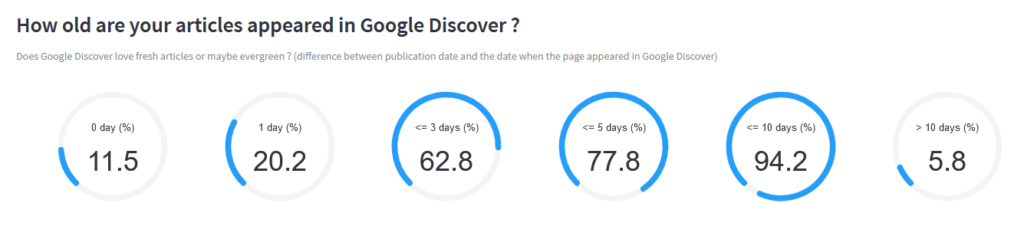
is a tool developed by foreign netizen Alexis Rylco. After being authorized to connect to GSC, it can be combined with Python to analyze the content and then visualize Google Discover data. Some very interesting reports can be seen, such as "How many web pages appear in Discover every day on average?", "The average number of days that a web page appears in Discover", "The words contained in the titles that most commonly appear in Discover"... and so on. It is very suitable for websites that are mainly content and have a certain degree of Google Discover traffic.

link:Google Discover Visualization Tool / tool introduction
It has been almost a year since the membership system of the e-newsletter was launched. I will go back to Taiwan to quarantine for 14 days to review and think about the next step of the digital engine. During the quarantine, everyone is welcome to message me on Slack to make an appointment to chat. I really need to hear your feedback~