This issue includes several items related to user experience and information architecture. Many readers may focus so heavily on SEO at work that they never touch these fields, but both are indispensable parts of a good website. I recommend occasionally picking up some knowledge from the neighboring disciplines too!
- [News] Data Studio Can Now Load Discover & News Data
- [Template] GSC Data Analysis Template
- [Tool] “Retail Search” for Better On-Site Ecommerce Search
- [Resource] BrightonSEO 2022 Slide Collection
- [Shared Examples] Good Ecommerce User Experiences
- [Tool] Download GSC Crawl Stats Reports
- [News] Major Publisher Sees No Traffic Loss After Turning Off AMP
- [Recommended Reading] Information Architecture
- [Video] Why Isn't My JavaScript Webpage Cached by Google?
- [Summary] Google Search Podcast—Structured Data
[News] Data Studio Can Now Load Discover & News Data
Discover and Google News data had been added to the GSC API back in October 2021, but only recently has the GSC connector in Data Studio gained the ability to load data from both directly. This is very convenient for content sites that receive traffic from those sources!
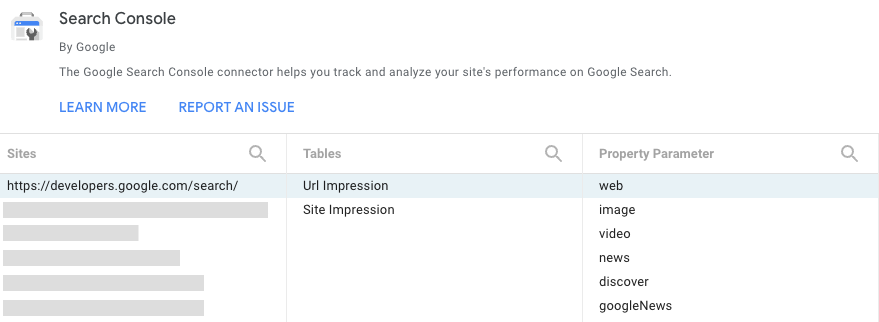
The source of this news is an official article explaining how to monitor a site's organic search performance with Data Studio. The article also provides a template for visualizing GSC data. Since the content is relatively basic and the template is not as attractive as the one in the next item, I will leave it for interested readers to explore and practice with on their own!
Links: Visualizing Google Discover / Types of articles in Discover / The difference between news and googleNews
[Template] GSC Data Analysis Template
First is the second version of Hannah's GSC template, whose original version I introduced in 2020. I have to say, it is genuinely comfortable to use. The first version was already quite good, but the second takes both the design and practicality to another level. You can apply it to your own GSC property with one click, and I highly recommend opening it and giving it a try!
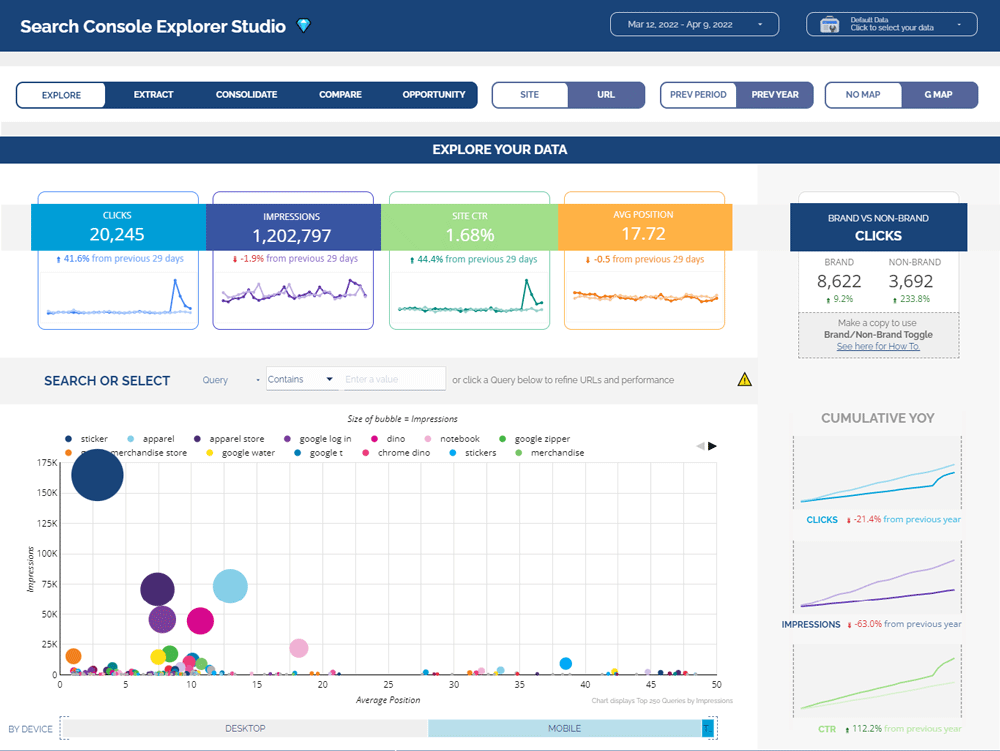
Links: Hannah's template / Introduction to Hannah's template / Introduction to bubble charts in Data Studio
[Tool] “Retail Search” for Better On-Site Ecommerce Search
First, this is not a free tool. It is a new service within Google Cloud designed to make on-site search results more relevant for ecommerce websites. For example, a user can search for “long black dress with short sleeves and comfortable fit” and find matching products.
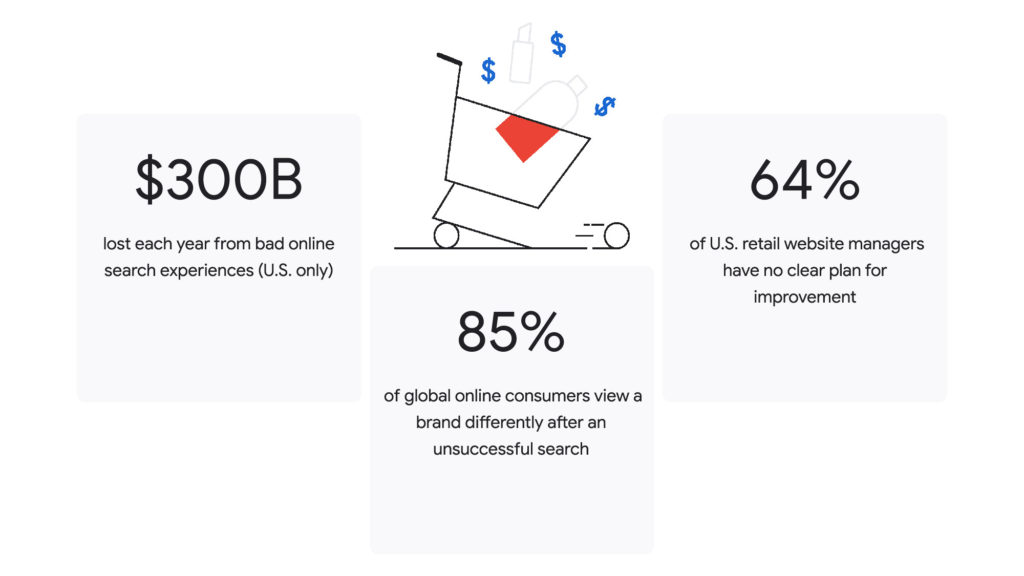
The product's launch announcement says that 94% of U.S. consumers abandon a shopping session because the product search results are irrelevant. On-site search on an ordinary ecommerce website is relatively weak and can usually perform only simple keyword matching. Users cannot search in natural language, so this tool's technology can address that conversion pain point.
One of the questions I was asked while interviewing for an SEO role at Amazon a few years earlier was related to on-site search. SEO focuses on organic traffic from search engines, but once the traffic arrives, CRO—conversion rate optimization—is another part of the process that cannot be ignored.
Links: Announcement / Product overview
[Resource] BrightonSEO 2022 Slide Collection
BrightonSEO held its first in-person conference in a long time in the United Kingdom in early April. The collection below contained 64 conference slide decks, with more still being added. I recommend scanning the titles and reading more closely wherever something catches your interest.
BrightonSEO will also hold another online conference on April 21–22 this year. The event is free to attend, although replays require payment. Anyone interested can register on their own.
- Lessons from hundreds of SEO A/B tests – Will Critchlow
- No more excuses: How to get your team doing UX as a part of your Digital Marketing now – Grecia Garcia Garcia, PhD
- SEO Automation Without Using Hard Code – T. Mert Azizoğlu
- What to do when what’s good for users isn’t good for Google – Will Critchlow
- How to do an ASO Audit like in the 90’s – Luis Bueno Tabernero
- Beyond the Basics – 5 (or 10) Google Business Profile elements you might not know about but REALLY should – Claire Carlile

Links: Slide collection—Google Sheets / Web version
[Shared Examples] Good Ecommerce User Experiences
Someone overseas shared several things that ecommerce webpages did well on Twitter. The author called them good examples of E-A-T, but personally, I think the examples were more about page elements that could improve the overall user experience. Here are a few of them:


I previously introduced a wireframe for ecommerce product pages, although the right design will naturally vary with the type of product. I strongly recommend looking at different ecommerce websites from time to time and thinking about which content helps resolve consumer concerns or improve conversion rates. Never treat an ecommerce webpage as nothing more than a page with an order button.
Links: Twitter thread / Stanford Guidelines for Web Credibility
[Tool] Download GSC Crawl Stats Reports
This Chrome extension, developed by Valentin, lets you visit Google Search Console after installation, turn the past 90 days of data from the Crawl Stats Report into charts, and download the results.
The crawl stats report in Google Search Console is somewhat hidden under “Settings” in the left-hand navigation. It shows what happened while Googlebot crawled the website and is worth checking occasionally for anything unusual.

Links: Official Crawl Stats Report documentation / Tool overview in the Chrome Store / Official video: crawl budget and the Crawl Stats Report
[News] Major Publisher Sees No Traffic Loss After Turning Off AMP
Future plc is a major British publisher whose brands include familiar magazines such as PC Gamer, Marie Claire, and TechRadar.

After testing, Future decided to turn off AMP across its websites and use ordinary mobile webpages. Across all its media properties, 80%–90% of pages are no longer using AMP, with no traffic loss. More importantly, ordinary webpages are not subject to AMP's restrictions, so Future can sell more ad placements and generate more advertising revenue.
Future originally adopted AMP for the same reason everyone else did: placement in Top Stories on the SERP. But after Google announced at I/O 2021 that AMP would no longer be required to appear there, the company began testing how to turn it off. Beyond that, Future also carried out a project during this period to optimize Core Web Vitals, allowing its sites to retain a good user experience after removing AMP. Many competing publishers do not have good mobile websites, which means they still cannot cut AMP so easily.
Links: Digiday article / AMP's antitrust controversy
[Recommended Reading] Information Architecture
NN/g is a well-known UX research and consulting organization. It recently assembled a guide to information architecture (IA), including what IA is, how to conduct IA research, and how to design a good browsing flow for a website.
Information architecture is the practice of organizing the information on a website efficiently so users can easily accomplish the goal that brought them there. Even if you have never heard the term before, you have probably already noticed how closely the concept relates to SEO. After all, our work also involves understanding what our target audience searches for and providing the content they need.
The guide contains 40 articles and videos in total, so save it and work through it over time!
Link: NN/g Information Architecture: Study Guide
[Video] Why Isn't My JavaScript Webpage Cached by Google?
In search results, you may occasionally see a webpage that Google has cached as a backup. When a website relies on JavaScript to display its content, the cached copy will usually show either a completely blank page or omit the sections that require JavaScript rendering.
In this video, John explains why this happens: the same-origin policy. He also says the best way to check whether a webpage's content has been indexed is through GSC, not the cached copy.
Link: Search Engine Land article about Google Cache
[Summary] Google Search Podcast—Structured Data
This episode brings in Ryan Levering to discuss structured data. Ryan is an engineer responsible for structured data at Google. SEO professionals generally treat “structured data” as synonymous with schema markup, but taken literally, it is not a very precise term. Whether data is “structured” is relative; even HTML can be viewed as textual data with structure added to it.
Ryan also says many people do not understand the relationship between Google and Schema.org. Schema.org is an organization built through collaboration among many companies, and Google is only one member. Schema.org includes all kinds of “Types” and “Properties”, but Google provides special appearances or features for only some of them.
Does adding schema that does not produce a special rich result help a webpage? Ryan says he would not discourage people from doing it as long as the schema was reasonable, because (1) it would help Google see that more people were beginning to use that schema, and (2) it might help Google understand the webpage's content a little better.
Links: Transcript / SchemaApp's introduction to the episode
I recently found an utterly pointless URL shortener that can make any URL look like a scam. For example, this newsletter became... http://www.5z8.info/girlsgonewildpart1.wmv_y3c2bw_snufffilms
Related reading
E-commerce product list page: striking a balance between SEO and user needs
summarizes the key points of an e-commerce category page optimization article, explaining that PLP should not stack irrelevant text for SEO, but should use content, navigation and testing to serve purchasing decisions.
Use Conversion Funnel to find at which step the user leaves
An analysis note starting from the shopping process, explaining how to break the conversion process into steps, and then use the churn position to find the pages most worthy of optimization.
From answers to journeys: Google’s three imaginations of search experience
Preserve three observations on the future of search as Google celebrates its 20th anniversary: from single answers to search journeys, from queries to active exploration, and from words to more visual information discovery.