
The content of this e-newsletter is full of good information. I think Google's new version of "How Google Search Works" is something every SEO should read. In addition, in the third episode of the podcast, you can hear how John uses Neural Network to describe the ranking system, which is worth savoring.
If you haven’t subscribed yet, the form has been moved up here for you! Part of the reason why there is less and less content on Facebook is because I put all my energy into email. If you don’t want to miss it, please hand over your email address~
- Document Update – How Google Search Works
- Structured data testing tool will be replaced
- Alternative tool for testing "structured data"
- The new version of Screaming Frog (v13) is officially launched
- "Type" of Google Discover articles
- WordPress plug-in "Web Stories" is open for testing
- Martin Splitt AMA (Stop talking about 2 wave indexing)
- [Official Announcement] How Google uses reporting reports
- GSC supports Regex filtering (cancelled again)
- SEO Mythbusters: Crawl Budget (Crawl Budget)
- Google Search Podcast EP.2 & EP.3
Document Update - How Google Search Works
Google has a web page talking about "How Google Search Works". Someone noticed that the content of this document has been modified a lot recently. Although there is no shocking new information, it can be seen from the changes in some words used by Google that they are trying to clarify the problem.
If you have never readthis page, it is recommended to read it, it can help you lay a good foundation concept; if you are a more experienced SEO person, you can read itComparison of this Google document before and after modification, from some new/deleted/modified parts you will find interesting evolutions in Google’s external explanation of SEO.

Among them, what I am most interested in is that Google has added a new paragraph explaining the differences between "Document", "URL", "Page" and "Version". This echoes the part where Gary explained document in the second episode of the podcast. Asking professional SEO personnel may not be able to explain the differences between these terms well, so it is worth reading!
Structured data testing tool will be replaced
Structured Data Testing Tool (SDTT, Structured Data Testing Tool) will be discontinued and replaced by Rich Results Test (RRT, Complex Search Results Testing Tool).
The biggest difference between the two is that SDTT can test any schema markup, regardless of whether there are any appearance changes in the search results. For example, if there is a "VideoGame" tag. Adding this tag to the web page will not cause any difference in search appearance. You can use SDTT on this page to see if the code is installed correctly, but on RRT it will only show that it does not meet the conditions.

link:official announcement / structured data testing tool / Compound search result testing tool
Alternative tool for testing "structured data"
Most people may not care about the above update, but some foreign SEOs or developers believe that the semantic meaning of a web page is the important part of Schema Markup, and the enhanced appearance of search results is just an added benefit. Google's position is that supporting schema without appearance changes may cause confusion for webmasters.
Twitter/X Post
View original post on Twitter/X
If you want to test other schema markups, you can consider using the following tools, some of which have pretty good visual charts.
The new version of Screaming Frog (v13) is officially launched
Screaming Frog v13 is launched, adding several cool features, including:
- Similar content analysis- See which pages may have similar content and duplicate content
- Pinyin and grammar correction- Finds grammatical and pinyin errors, also in Chinese! (but full of birds)
- More link information- Contains the location of the link (header, footer, etc)
- renderingHTML comparison before and after dyeing
Twitter/X Post
View original post on Twitter/X
"Type" of Google Discover articles
Google Discover automatically recommends articles by Google without any search action by the user. Someone found that it can be passed through"Send Feedback" > "System Logs > Card Category"See why Google recommended this article to you.
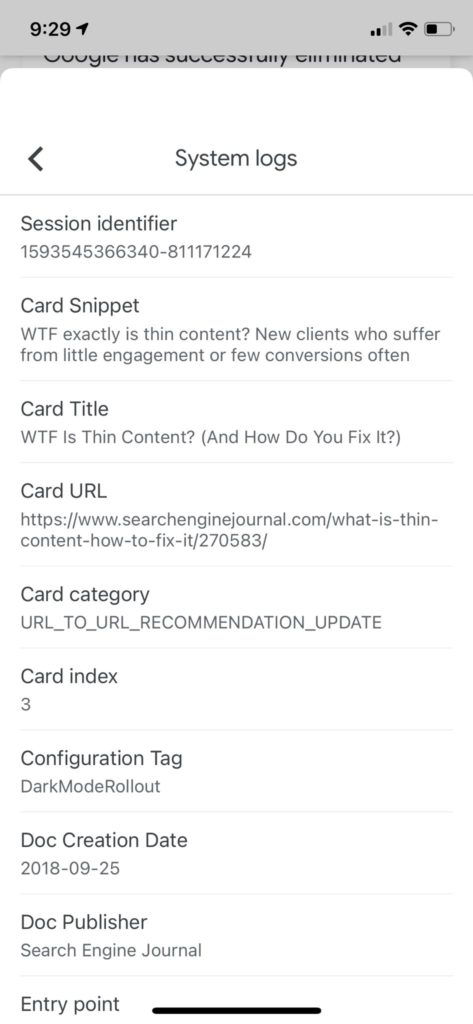
For example, the recommended reason in the above picture is "URL_TO_URL_RECOMMENDATION_UPDATE". The exact meaning behind these names is probably only known to Google engineers, but someone put together oneformput all the Discover types he saw, which is quite interesting.
Wordpress plug-in "Web Stories" is open for testing The WordPress plug-in for
Web Stories (formerly known as AMP Stories) is now in the Beta testing stage. Those who are interested can play it. I personally think it is a good way to present content.
If you still don’t know what Web Stories are, you can refer to this article I wrote beforeAMP Story article, recently I posted a previous articleLeo Burnett and The North Face SEO Casehas been made again, welcome to take a look!

link:Web Stories for Wordpress plugin
Martin Splitt AMA (Stop talking about 2 wave indexing)
Martin Splitt held an AMA (Ask Me Anything) on Reddit, which answered many questions about Javascript and SEO.

One noteworthy point is that Martin said he no longer uses the metaphor "two-wave indexing" because it creates more confusion and keeps many people away from JS Site. Basically every web page now has a rendering process, and the median time a web page waits for rendering is only about five seconds.
link:Reddit thread
[Official Announcement] How Google uses reporting reports
Gary Illyes wrote an article "How spam reports are used at Google", discussing how Google uses user reporting reports in search.
If users find websites that use black hat SEO, they canSpam ReportReport this to Google. But Google does not review them one by one. They mainly use these reports to optimize their spam detection algorithm, because this is a more scalable method.
GSC supports Regex filtering (cancelled again)
The filtering function of GSC is quite criticized, it can only be simple "equal to" or "includes". Recently, someone discovered that a Regex Filter description was added to the GSC usage file, but it was removed within a few days, which made many SEOs happy.

If you need to process GSC data, the easier way is to connect GSC to Data Studio or Google Analytics. Both tools support Regex.
SEO Mythbusters: Crawl Budget (Crawl Budget)
This episode of the MythBusters series discusses crawl budget. Martin mentioned in the video that the crawl budget is not an issue that medium-sized or small websites need to pay special attention to. Google's position is to crawl as much information as possible on the Internet with limited resources.
What types of websites should be crawled more frequently (crawl demand), how to limit the speed of Googlebot when accessing web pages (crawl rate)...etc., you can hear the official answers in this video.
Google Search Podcast EP.2 & EP.3
This is the second and third episodes of "Search Off the Record", which contains quite a lot of useful information. In the second episode, Gary talked about the reasons behind the Google index problem in early June, and explained what "Document" is (echoing the previous how search works); in the third episode, John spent some time talking about "ranking factors". He compared Google's ranking to a neural network. network), believes that rankings should be viewed as a whole, rather than just focusing on a certain factor, or thinking that those factors are more important.
If you have benefited from the e-newsletter, please leave a message or send me a letter~ Otherwise, I always feel like I am talking to the air. Now I know how the teacher on the stage felt before XD
Related reading
Can search engines really see the content generated by JavaScript?
Saves a practical note on using the Search Console URL inspection tool to confirm whether JavaScript content is rendered, and links back to the basic article on search engine crawling and indexing.