This issue of the e-newsletter contains a lot of information that needs to be read. I will try my best to help you extract the essence. However, there is too much content that can be summarized, so I recommend that you go to the original source and read it yourself if you have time! The following is the content of this issue:
- [Good article] SEO observations on Airbnb’s new design and category pages
- [Research] The correlation between internal links and SEO traffic
- [Good article] Discussing the thumbnails of Google search (Thumbnails)
- [Interesting Facts] Black hat SEO personnel share their experiences
- [GA4] AMP cannot use GA4 and its solution
- [Resource] Tag reorganization in <HEAD>
- [Official] How Google generates titles for documents with inconsistent languages
- [Video] Why nothing is done and the chart in GSC fluctuates
- [Video] Eight tips to make your e-commerce website mobile friendly
- [Abstract] Podcast – Web 3.0
[Good Article] SEO Observations on Airbnb’s New Design and Category Pages
In May 2022, Airbnb revised its website and launched 56 new category pages, such as "Amazing Views」,「Chef's Kitchen」,「OMG!」,「Creative Spaces"...Wait. Kevin Indig posted on thisan articleshared his opinion on what Airbnb’s SEO can be improved in this revision.
Airbnb has launched these 56 categories in 100,000 cities, so there should be 5.6 million independent URLs that can be included. In fact, the area that Kevin mentioned that can be improved is Airbnb’s “City+Classification The page "" uses a parameter URL and cannot be included (for example:Treehouse in Oregoncannot be included).

I think the part about search and taxonomy in the article is more worth reading. He believes that the essence of "search" is that users know what they want, but most of the time users don't actually know it. For example, I am concerned about Airbnb's new "Creative Spaces"I am interested, but I will not search like this at the beginning. Google Discover's "searchless" search is a similar concept.
Secondly, taxonomy can be divided into two categories. One is hierarchical classification, which is common in general websites, especially e-commerce. The other is non-hierarchical, such as tag system. There are multiple web pages under one tag, but the most important thing is that one web page can belong to multiple tags. For user experience, we often only focus on the first classification method and ignore the second classification method. Airbnb's new classification method creatively finds similar properties in products and labels the products to classify them.
link:CNBC reports that airbnb revamped its website / SEO analysis of Airbnb’s previous web page revision
[Research] The correlation between internal links and SEO traffic
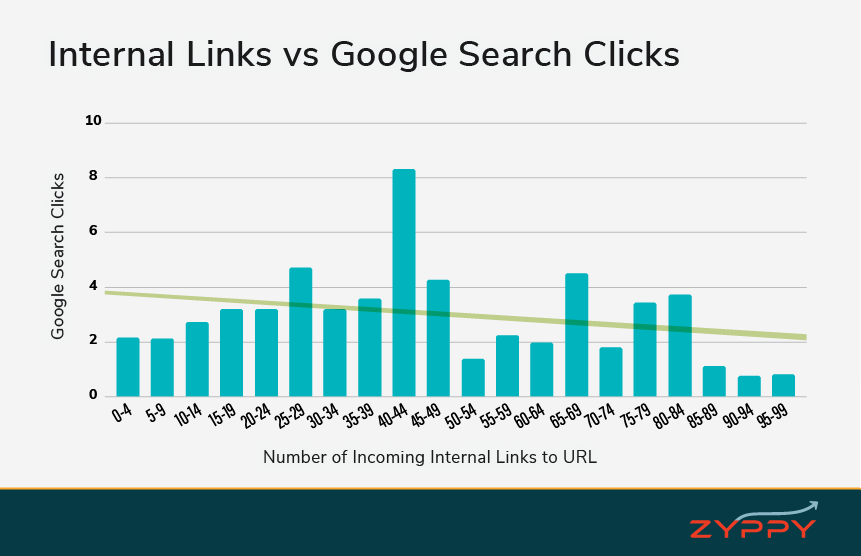
The company Zippy studied 1,800 websites, 520,000 URLs, and 23 million internal links, and compared the clicks of the URLs in GSC to try to see the correlation between internal links and SEO traffic. Although the number of samples observed in this type of research is definitely not comparable to that of Google, some observations are still worthy of note and quotation.
When the number of internal links is in the range of 40 to 44, GSC's click volume is the highest, and then it starts to decrease. This may be because internal links of the navigational or sitewide type represent less value than links that appear within body text.
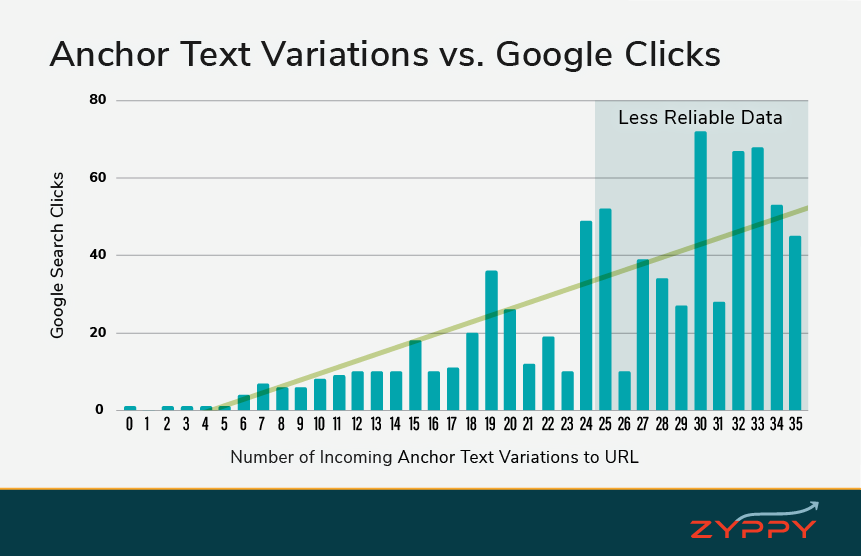
In addition, the more varied the linked anchor text of a web page is, the stronger the positive correlation is with clicks in GSC. This is somewhat related to the observation about sitewide links above, because there will only be one anchor text if the link appears in the template.
link:Zippy original text
[Good article] Discussing the thumbnails of Google search (Thumbnails)
Brodie ClarkThis article studies the web thumbnails (thumbnails) on Google search very carefully. The so-called thumbnails refer to the following, which may have a row of pictures or a single picture. This thumbnail has been available on mobile phones for a while, but has only started to appear in large numbers on desktop searches in the past year.

The article states that thumbnails appear in approximately 40% of desktop searches and 65% of mobile searches. In addition, Google will only allow up to four web pages to have multiple thumbnails on one search result.
In addition, regarding the appearance of "a row of thumbnails", the article provides three reasons to explain why the webpage does not have multiple thumbnails. The first is pure ranking. Google believes that other web pages are more worthy of having multiple thumbnails; the second is display reasons, you can site: the web page and add keywords to know whether the web page is qualified; the third is indexing issues, whether the images on the web page are not seen at all.
There are many observations in the article, including his list of eight reasons why it’s easier to have a multi-thumbnail appearance on a web page.
link:Original link
[Interesting Facts] Black hat SEO personnel share their experiences
Reedit ForumA black hat SEO person shared his operating experience on the Internet. The original intention is to let everyone understand the other side. I don’t encourage everyone to learn, but it is always good to have more opinions~ His method is roughly as follows:
- Throw in a recommended keyword on Ahrefs
- Grab the questions from People Also Asked
- Use machine production methods to write thousands of articles
- Publish it on an old domain that I bought before and leave it there for 3 to 4 months
- Go to GSC and see which words perform best
- Please ask real writers to write good content on these words
- Publish content written by "humans" on another white hat website and remove machine-generated content on black hat websites to avoid competing with each other
Points six and seven are quite interesting. He is not just polluting the entire Internet world, but using black hat methods to do keyword research and content ideas. In the comment area below, he also mentioned that for articles written by real people, his success rate in getting ranked is about 99%.

link:Does automatically generating content violate Google policy? / How do writers produce articles in 38 seconds?
[GA4] AMP cannot use GA4 and solutions
GA4expectedIt will completely replace the current universal analytics next year, but Google's handover plan for many things is not perfect. One of them is that AMP websites (whether they are partially or fully AMP-based websites) have not yet installed GA4 in a default way.
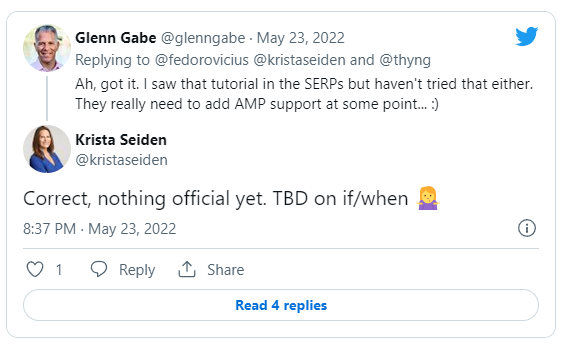
But if you really need it (you can’t or don’t want to turn off AMP), a strong person has written a guide that provides a solution for tracking GA4 events on the AMP site. Although I don’t have time to test it, but after a brief look at it, it seems that it is quite detailed. The basic tracking only needs to be modified.<amp-analytics>The content in it is enough, but the article also talks about more in-depth things (cookies conset, web vitals, etc).

link:Major publisher sees no traffic loss after switching off AMP / Antitrust disputes over the AMP project
[Resource] Cleaning up tags in <HEAD>
I accidentally discovered this document, which lists a variety of tags that appear in HTML <HEAD>. Only a small part of them are related to SEO, and many are related to social media, or tags that are listed in Internet standards but may not necessarily have practical uses.
Some of the more interesting ones I saw include how to control the appearance of web pages shared on QQ/WeChat; preventing people from adding web pages to Pinterest tags; except for pagination-related tags.rel="next"andrel="prev"In addition, it turns out there arerel="next"andrel="next"...etc. all kinds of cold knowledge, I recommend readers who are interested to check it out!

[Official] How Google generates titles for documents with inconsistent languages
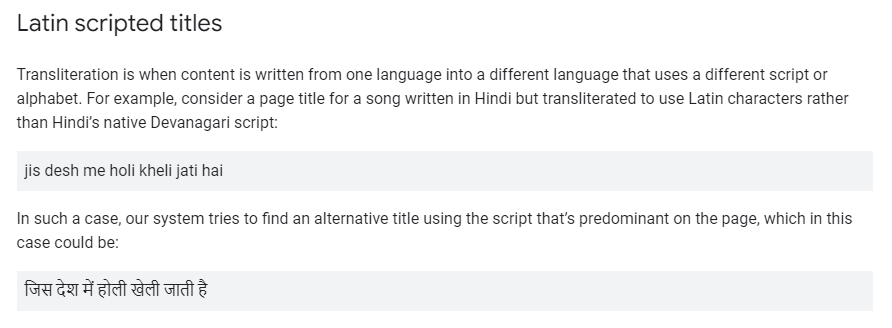
Google thisnew documentIt is said that they have an algorithm advancement that will determine if <title> is inconsistent with the main language of the web page and rewrite it.title link(title on search results). Two examples are given:
Scenario 1: When the title appears in both Hindi and English, but the content is mainly in Hindi, remove the English part of the title.
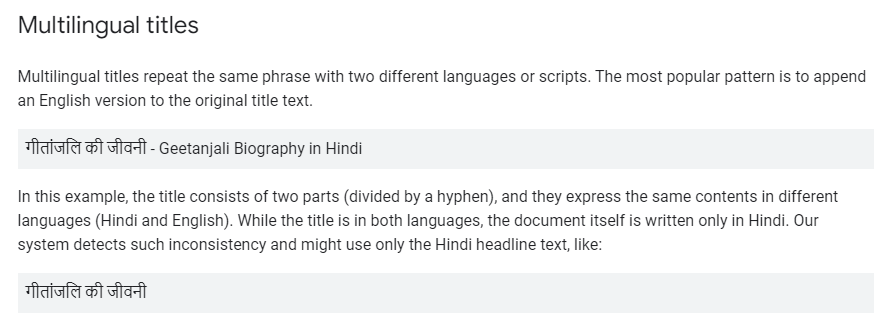
Scenario 2: When the content is mainly in Hindi, but the title is the Roman pinyin of Hindi, convert the Roman pinyin to Hindi. This may be difficult for Taiwanese who use Zhuyin to understand, but it can be thought of as a simplified Chinese web page with the titleshu wei yin qing, Google will change it to数位引擎。
[Video] Why nothing is done and the chart in GSC fluctuates
John was asked why the reports in GSC (such as "Index Coverage Report") of a website that has not changed anything still fluctuate?
John said that this is a very normal phenomenon. The system behind Google is very complex, and different data centers will not be synchronized at all times. Therefore, it is recommended to (1.) Don’t pay too much attention to small fluctuations or be sure to find out the root cause; (2.) Focus on the medium and long-term trend, whether it continues to go up or down; (3.) Pay special attention to the sudden rise or drop in the chart, which means that Google has encountered a new situation when crawling the website.
[Video] Eight tips to make your e-commerce website mobile friendly
may make many people feel that it is too simple and they are too lazy to click on the video. The techniques mentioned in the video are nothing more than "enhancing website speed", "ensuring that the content can be seen"... and so on, so they are not listed here.
But I actually recommend that you spend 15 minutes reading it. It mentions a lot of technical SEO stuff, which gave me the feeling of reviewing it or learning new knowledge, such asallows the form to be filled in correctly (auto fill), optimal click area...etc.

[Abstract] Podcast - Web 3.0
In this episode, several people get together to discuss Web 3.0, a next-generation online world that is gradually being discussed with the blockchain craze. The contents are only their personal opinions and are not Google’s official position. Whether you are a novice who is not familiar with this concept or someone who has already stepped into the world of blockchain, I highly recommend listening to this podcast episode. It talks about the web3 concepts they know from the simplest to the more profound, and it does not always mention the benefits of web3 like the articles in the chain circle.
First of all, of course, define Web1 and Web2. Web1 refers to the earliest Internet. It is not easy to store and update physical data, so it is put on the Internet so that everyone can browse it directly, which is considered Read Only. Next is Web2, where people can communicate with others through social platforms, or easily set up their own website or upload content to platforms such as Pixnet and YouTube, which is considered Read & Write.
Finally, there is Web3. We no longer want to be kidnapped by the platform, and we do not want our content to lose value due to changes in the platform's policies or algorithms, but we want to truly "own" the content.
The three also discussed content placed in the Walled Garden (content behind a paid or subscription wall) and why more and more creators do not want content to be absorbed for free. Martin believes that this is all related to the exchange of value. The owner of a business will be willing to put content on Facebook, because in addition to adding content to Facebook, it also provides a channel for him to be found, and both parties gain value; but for creators, the value to Facebook (platform users seeing good content) may be far greater than the value to the creator (a few likes + a sense of accomplishment) when posting valuable works to Facebook.
If you are also a leek who has been exposed to blockchain, let’s warm each other up...
Related reading
E-commerce product list page: striking a balance between SEO and user needs
summarizes the key points of an e-commerce category page optimization article, explaining that PLP should not stack irrelevant text for SEO, but should use content, navigation and testing to serve purchasing decisions.
Blank category page: noindex, soft 404 and page change signal
Starting from the discussion of blank category pages in e-commerce, we sort out the differences between noindex and soft 404, and how changes in content, internal links, and products can serve as signals for re-examination.