There are two newsletters in this issue that I particularly like. One is about how to quantify marketing results, written by Rand Fishkin, whom I haven’t seen for a long time. As usual, his articles have titles that may seem trivial but are very rewarding to read. The other is about Python teaching. You can learn new modules or writing methods from other people’s codes every time. I recommend everyone to click on the original article and try to read it!
- [News] October 2022 "Spam Content" Algorithm Update
- [News] "Website name" is added to the mobile phone search results
- [Official] About GSC data filtering and restrictions
- [Tool] Free Rank Tracking Tool – SEOTesting.com
- [Resource] BrightonSEO 2022 Briefing Compilation
- [Good article] How to quantify marketing channels that are difficult to quantify
- [Learn] Use Python to find the common words on the top few web pages
- [Video] SEO in the same country but different regions
- [Video] Do web pages have to have a meta robots tag?
- [Abstract] Let’s talk about image SEO
[News] October 2022 "Spam Content" Algorithm Update
This update will be launched between 10/19~10/21, 2022. Although regarding spam,official document There are many categories on, but everyone in the community believes that this update will have the most severe impact on content produced by AI, and the blow will be powerful.evenThe traffic of some websites has been reduced to close to zero.

Neil Patel said that his company has hundreds of websites that rely on AI to produce content, and has used them to analyze. He came to the conclusion shown in the figure below. The traffic of content websites produced purely by AI dropped by 17.29% after the algorithm was updated. Content that was supervised and modified by someone had a lower traffic drop.

link:Officially announced algorithm update list / Google’s Spam Policy
[News] "Website name" is added to the mobile phone search results
is followingDigital Engine Fan Special Readers ofshould have already seen the news about SERP appearance changes: Google will display the website name (site name) in mobile search results to make it easier for users to identify the website.
Google will mainly refer tofour sourcesto determine the website name, we can also usestructured dataspecifies the website name or alias, this Just use the popular usage of the name, full name is not required or recommended (for example, replace “Google, Inc” with “Google”); it has not been crawled or hasOther conditions(such as a website using a subdomain or an unrecognizable name), the "site name" will be changed to display the domain. Jemmy byJKLunexpectedly observed that the Chinese domain gained better exposure during this transition period.

This update only supports mobile search results in English, French, Japanese and German at the time of announcement, and is expected to be rolled out to other languages in the coming months. Now, as long as you change the "search result language" of your browser to English, you can see the display status of your own webpage~

link:official announcement / "Website name" documentation / Further reading: "Website icon" documentation
[Official] About GSC data filtering and restrictions
The most widely used information in Google Search Console is the website's search performance, but how these data are recorded by Google has many details, such as "If a search term appears on two pages of the same website, how will the ranking be recorded? How is the ranking of」、「recorded in the knowledge panel? Will」、「appearing on the People Also Ask page be counted as exposure?", these questions can be found hereofficial document Get the answer on.
Daniel Waisberg recently posted an article to discuss another often confusing part of GSC - data filtering and restrictions. Due to privacy concerns, Google does not provide website exposure and clicks for each search term.These anonymous data will be reflected in the totals but will not be listed, so the line-by-line numbers will not tally up with the totals. Adding the numbers one by one in
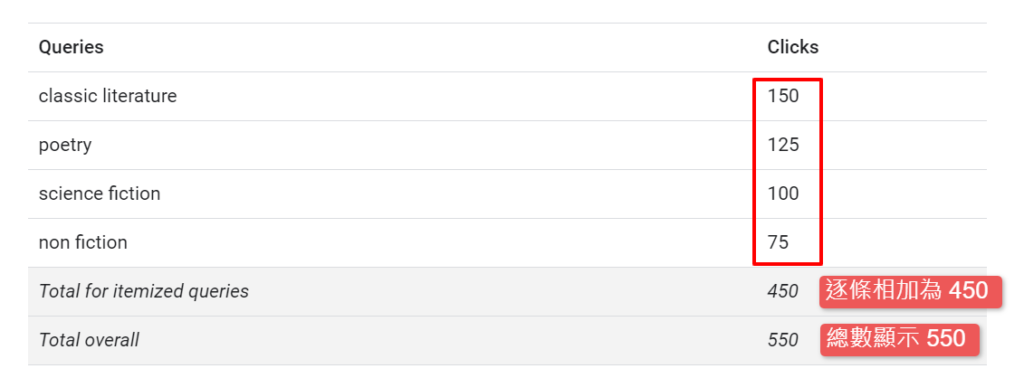
In the case of the above picture, if the filter is包含fictionwill get 175, filtered to不包含fictionwill get 275, which adds up to 450, which is different from the real total of 550 because the hidden data accounts for 100 clicks.
link:official article
[Tool] Free ranking tracking tool - SEOTesting.com
This simple little tool can track the ranking of multiple websites and monitor it for specific devices and regions. Officials say that each website can only track a maximum of 500 word groups at the same time, but according to the author's actual testing, the same website can create multiple tracking projects, which means there is no upper limit for tracking word groups. You can also use this method to classify and track keywords.
The data source of this tool is only Google Search Console, so everything it can do can be done by GSC, but I like that it compiles the ranking results at different times on the same table, so that users can quickly monitor the ranking changes in each period. Such checking operations are more cumbersome on GSC.
The second useful feature is email notification, which tells you the ranking status of all websites in one email every day. If you are usually inundated with all kinds of emails, you will definitely like this simplicity!

SEOTesting.com launches such a tool, giving SEO personnel who do not consider purchasing paid tools another option. Their specialty is actually providing performance tracking reports for SEO experiments (such asNew included page promptorGroup test observation tool), saving SEO personnel time to retrieve information before observing the results. If you have used their products, welcome to the Digital Engine member group to share them with everyone!
link:Tool Link / Product Hunt Page
[Resource] BrightonSEO 2022 Briefing Compilation
Previous issueintroduced BrightonSEO, a free SEO seminar. If you missed it, some netizens compiled this public briefing. Generally, foreign speakers are happy to share their presentations. Although there will be no context without the video, you can still dig out some good tools or data for reference.

digital engine inIssue 54andIssue 29has also compiled past BrightonSEO briefings, you can go back and read them if you have time!
[Good article] How to quantify marketing channels that are difficult to quantify
This article was written by the long-lost Rand Fishkin. The opening paragraph of the article attracted my attention. He said that too many company executives now only focus on measurable marketing proposals. If it is growth channels that are difficult to measure accurately, such as PR, community management, and activities, they are often not taken seriously. Marketing Before the rise of online privacy, marketers had a lot of data, which fostered everyone's reliance on "traceability." As the Internet ecosystem becomes more complex, there is now less and less data to rely on.
It is true that some very cool analysis models have appeared on the market to try to reconstruct the lost data, but maybe what everyone should think about is to think from a different angle and use more indirect methods that require some intuition and creativity to measure what we are doing, rather than blindly trusting the data spit out by the tools. This is back to the way marketers measured TV advertising, in-store promotions, radio, etc. before the advent of the Internet.

It is highly recommended that everyone think about it after reading this article. In addition to conversion, are there any other indicators that can be used to convince senior management or customers of the value of what we are doing.
link:Rand FishkinOriginal article
[Learning] Use Python to find the common words on the top few web pages
This Python script can input a word, and then (1.) scrape the search results, (2.) grab the content on the high-ranking web pages, (3.) use the TextRank model to find the most frequently used words in these top-ranking web pages.
To be honest, in terms of practicality, I think people have different opinions, but the author has given his own Python program code, and also has the following teaching video to walk you through each step. It is very detailed and is very suitable for people with some Python basics to use as an exercise or review, or for people without basic knowledge to understand what Python can do!
link:GitHub Repo
[Video] SEO in the same country but different regions
I believe everyone knows that multi-national/multi-language websites can use hreflang to declare, but what if the content has a more detailed regional nature, such as a state in the United States or a province in Canada? John did not have a very positive answer in this video, but he said that Googlebot usually only comes from one place (California, United States), so IP-redirect or limiting web pages to only people in specific areas are very bad.
If the website has regional content, you can still rely on IP to detect the possible location of the user, but the more recommended approach is to pop up a notification asking them if they want to be taken to another page, rather than forcing redirection or prohibiting entry.
link:Manage multi-country and multi-language websites
[Video] Do web pages have to have a meta robots tag?
Some people think that every web page must put
The webpage will be included only if you have the tag<meta name="robots" content="index, follow">, but this is actually completely unnecessary. In this video, John answered netizens’ doubts. If you don’t want the search engine to do anything extra, the meta robots tag is a dispensable tag.
meta robots tag can restrict the behavior of search engines, except for the most well-knownnoindex, andnoimageindexcan restrict the pictures on the web page from being included.nocachecan restrict others from seeing the cache of the web page,max-snippet: 20can limit the snippet of web pages on the SERP to a maximum of 20 words. It is recommended that you review it.this document, which also talks about the data-nosnippet tag that less people know but is also very useful.
[Abstract] Let’s talk about image SEO
This podcast episode features John and Lizzi discussing image SEO. John said something that I deeply agree with. He said that many SEO personnel directly want to jump into the N methods of optimizing image SEO, but they should go to a higher level and first think about whether the images on the website have any "search value". If so, then think about how to optimize them, because not every image should have keywords, such as decorative images or functional patterns.
In addition, if the file name of the image contains descriptive text, it can help search engines understand its content, but John does not think this is a big factor. If the image already has alt text or there is related content nearby the image, then Google can usually already understand what the image is related to. This is very similar to the discussion of whether a website should have keywords. If it does, it’s good, but if it doesn’t, there’s no need to change it just for the sake of changing it.
The last point is an important point that I haven't thought about before, but it is also quite reasonable. The same image often has different sizes, crops, or file formats. It is completely OK to have them all included by Google. Google's system will determine by itself which images are actually the same file. This is different from using canonical to declare different web addresses.
link:verbatim draft
I have read a lot of articles related to digital nomadism recently and decided to find time to go to Chiang Mai next year~