There are two of my favorite contents in this issue. They are the first article where Google generously talks about their well-known algorithms. The official compilation is still the most trustworthy source of information. The other one is Article 5’s AI application. My eyes light up when I see someone I haven’t seen for a long time. I hope everyone will feel the same!
- [Official] Detailed analysis of Google’s ranking algorithm
- [News] GSC adds Shopping Tab Listings function
- [Abstract] SMX Next Interview Google Search VP
- [Share] Four presentation methods of website links (Sitelinks)
- [Tool] Use GPT-3 to find content topics (+ free Google Sheet templates)
- [Good article] SEO indicators and reporting ideas
- [Research] JS websites take nearly 9 times longer to be fully crawled by Google
- [Tools] 3 tools to identify whether content is generated by AI
- [Video] Moving a 20-year-old website to React
- [Abstract] Two or three things about Redirect
[Official] Detailed analysis of Google’s ranking algorithm
Google recently addeda documentrecords several famous Google search ranking systems - including BERT, Helpful Content "System"... and so on. published at the same timeAnnouncement In, Danny said that the word "update" caused a lot of misunderstandings. For example, the system for judging whether content is useful used to be calledHelpful Content "Update", but when this system is updated, it will become helpful content update update, which is confusing to pronounce, so we will use system to refer to it in the future. The famous systems listed in the
document include the following. If there are any unfamiliar terms, it is recommended to go and take a look at the introduction! At the bottom, you can also see several famous systems that have been retired (or merged into existing systems), including panda system, pagespeed system, etc.
- BERT
- Crisis information systems
- Deduplication systems
- Exact match domain system
- Freshness systems
- Helpful content system
- Link analysis systems and PageRank
- Local news systems
- MUM
- Neural matching
- Original content systems
- Removal-based demotion systems
- Page experience system
- Passage ranking system
- Product reviews system
- RankBrain
- Reliable information systems
- Site diversity system
- Spam detection systems


link:Google Search Ranking System Guide / related announcements
[News] GSC adds Shopping Tab Listings function
In the "Shopping" area of GSC, eligible websites will begin to see a new "Shopping tab listing" in the next few weeks, and you can register a Merchant Center account here. After completing this step, merchants do not need to submit product feeds. They only need to ensure that the product structured data on the web page is kept updated so that the products can appear on the Shopping tab (shopping.google.com).
According to the help documentationDescription, the definition of eligibility is when Google detects product structured data and determines that the website is a website that sells physical goods.


link:Announcement / New Reports in GSC - Merchant Listings
[Abstract] SMX Next Interview with Google Search VP
This time SMX Next invited HJ (a.k.a. Hyung-Jin Kim, VP Search at Google) as the keynote speaker. The sharing topic is [What’s now and next with Google Search: Algorithm updates, E-A-T, and more]. The author has selected the following key points to share with you.

The first point: "E-A-T principle" (Expertise, Authoritativeness, and Trustworthiness) applies to all search situations
People often talk about the E-A-T principle and YMYL content (your money, your life) together, even Google’s official "Search Engine Evaluation Guide》All specialshows the correlation between the two, but HJ tells us that the E-A-T principle applies broadly to all search situations and search terms. It is not difficult to understand. Not only in the health or medical field, almost all industries can use three indicators: expertise, authoritativeness, and trustworthiness to judge whether the content of the website can help users.
E-A-T was written into the "Search Engine Evaluation Guide" in 2014 and began to be widely discussed in 2018, butGoogle has been applying it to search engines since around 2009!
The second point: the Search Quality team can also be "emotional"
The search quality team (a department within Google that specializes in researching and adjusting search result rankings) usually relies heavily on data, indicators, and various new technologies to optimize the ranking system. But they sometimes have to make subjective adjustments from the user's perspective.
The third point: "First-hand information" or "First-hand experience" plays a key role in a good piece of content.
Although there are many great takeways in the lecture, the author still wants to emphasize the importance of native content and high-quality content again. This is also the case in recent times.Comment algorithm update
A big highlight of. HJ took himself as an example. If he wanted to find a new tennis racket today, he would like to see content shared by netizens who "really took the time to use and test the product" rather than "collect information from other web pages and piece it together into an article and finally summarize it out of thin air."
In addition to the above three points, there are a lot of little knowledge worth listening to (for example, how Google has updated many new technologies such as BERT in recent years while the ultimate goal remains unchanged), you can read this articleKey summary compiled by SEL (SMX organizer), or directlyWatch the full lecture online(Registration required), this lecture does not have any briefings and can be listened to as a podcast.
link:SEL summarizes 7 key points / SMX Next 2022 All Agenda / Extended reading: Panda algorithm goes into history and evolves into raccoon algorithm
[Share] Four presentation methods of website links (Sitelinks)
Sitelinks are a bonus that greatly affects the search appearance. Brodie Clark has compiled four types of Sitelinks. The largest one usually appears when searching for a brand name. Users can access other pages on the site through links:

Jump-To Sitelinks requires burying text anchors to allow Google to generate links. Users can link to other paragraphs on the same page:

The author organized and tabulated these four Sitelinks into the following figure, which is relatively simple and clear:

What is more special is Scroll-To Sitelinks, which almost relies on the search engine to understand the meaning of the text and generate appropriate links for the search terms. After clicking, you can jump to the relevant content of the page. The url syntax of Scroll-To Sitelinks is "Copy link with highlighted text" when right-clicking on chrome's highlighted text. However, I tried a few times but didn't encounter it. If any readers encounter this kind of sitelink, you can share it with everyone in the slack group!
link:original tweet
[Tool] Use GPT-3 to find content topics (+ free Google Sheet templates)
I believe that everyone may be a little tired of the various AI tools, but this application is really quite smart, from an angle that has not been considered before. The process will be clearer by watching the video below, but conceptually it is (1.) Download GSC data; (2.) Find the articles on the website and their ranking keywords; (3.) Climb out the title of each article; (4.) Compare the title and ranking name using the GPT-3 model to determine the relevance score; (5.) Recommend an article outline.
Twitter/X Post
View original post on Twitter/X
According to this idea, if the relevance score is low, it may mean that there is an opportunity to write a special piece of content for this keyword, or to extend the original article with this keyword.


link:Article introduction / Twitter discussion thread & video introduction
[Good article] SEO indicators and reporting ideas
The author divides the indicators commonly used in SEO into four categories, from technical indicators that are farthest from commercial interests, to traffic & revenue indicators that bosses love to see. The article also describes the groups for which different types of indicators are suitable. SEO personnel should choose different indicators according to different audiences when reporting, and do not expect that the relationship between different types of indicators will be obvious.

The latter part of the article lists several self-examination questions when analyzing data, as well as principles for reporting in organizations. The article is not long, but it is a very worthy reference for ideas and framework. I recommend it to everyone!
link:original
[Research] JS websites take nearly 9 times longer to be fully crawled by Google
We all know that Google can crawl web pages generated by JavaScript (JS), but is the crawling situation the same as that of pure HTML web pages? Is there a time difference? Onely, a foreign company, conducted this experiment and the results showed that compared to websites generated by JS, pure HTML websites were nearly 9 times slower to be crawled by Google.
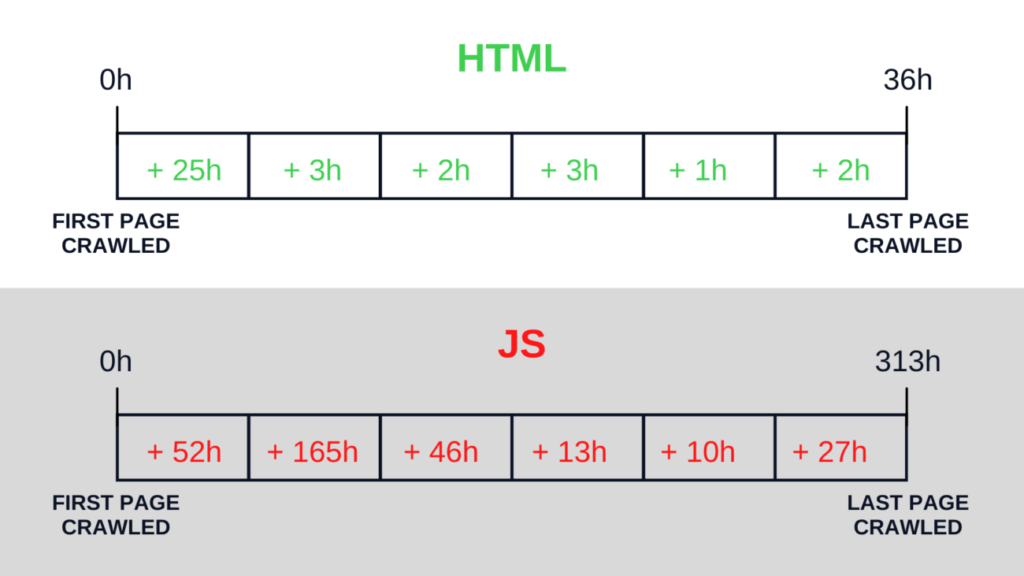
The experimental method is roughly as follows. First, two sets of pages are created (Pure HTML & JS generated content), starting from the first page of each set, a text link to the second page will be inserted into the content. In this way, it will continue to the seventh page. The only difference is that the content and links of the second set of websites are all generated by JS. The author wants to understand the crawling time of Google for different methods of generating web pages in this way.
This experiment is simple but thoughtful, even though Google has saidRendering of JS can usually be completed in 5 seconds, but this experiment believes that if the website relies on JS to generate content & links, it will greatly reduce the speed of web page crawling, so JS should still consider using technologies such as server side rendering.
link:Research the original text
[Tools] 3 tools to identify whether content is generated by AI
In the past, many tools and applications for AI-generated content have been introduced (for example:How do writers produce articles in 38 seconds?), this time from a different perspective, I will introduce how to determine whether a piece of content is generated by AI.
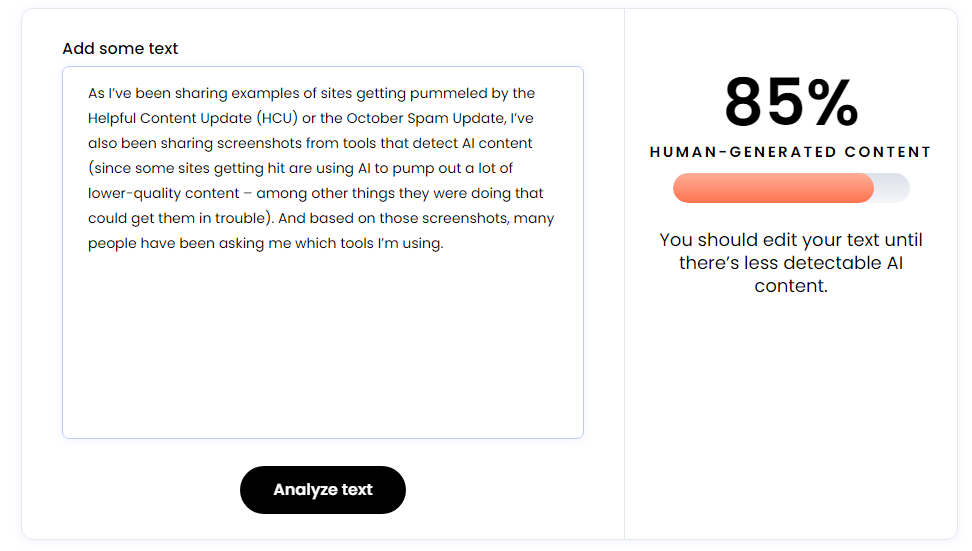
The original article was shared by Glenn Gabe. Three AI article identification tools -Writer’s AI content detector tool, GPT-2 Output Detector Demo, Giant Language Model Test Room (GLTR.io)
The first two tools are very intuitive. Enter a piece of text and press analyze, and a score will pop up representing how likely it is that the content was written by a real person.
thirdGLTR.ioIt is more complicated. Although it is also a one-click analysis, comparison details are provided. From the results, you can see that the text appears on the bottom of the net in different colors. Each word is compared to the previous word. If the word is easily predicted based on the previous word, it will be displayed in green. The probability of being predicted will be displayed in green > yellow > red > purple in order to determine the probability that the article was generated by AI. This website also has sample text generated based on different algorithms, as well as real-life articles from the New York Times and other places for testing, which is very fun.

The above tools are for reference only. It does not mean that low AI content will lead to good rankings (and vice versa). If you use AI tools to assist content production, remember to manually review it again.
[Video] Moving a 20-year-old website to React
In this video, Martin invited a guest (Roxana Stingu) to share the process of moving a 20-year-old website with nearly 300 million web pages to the React+SPA (single page application) framework and the problems encountered in the process.
The problem the sharer encountered was that on some web pages, what Googlebot saw was different from what the user saw on the browser. They tried to control possible variables (ex: switching user-agent, changing browsers... etc.), but they all saw different results, and finally found outThe web page may be changed according to the content of the browser's cookies.. Martin said that although it is not common (cookies are usually used for less relevant content, ex: "content that has been viewed"), it is indeed interesting.
For website changes of this scale and complexity, I originally expected to have more difficult situations and sharing. Unfortunately, there is no further sharing in the video, but cookies are also a direction worth checking.
[Abstract] Two or three things about Redirect
In this podcast episode, John and Martin talk about Redirect. There are several concepts that are not often heard and are worth taking note of.
1.) Martin mentioned that in addition to the essential conceptual differences, 301/302 will also affect the behavior of browsers in practice, such asMost browsers will cache 301 records。
2.) The difference between 301/302 and 308/307 is that the latter can be used for post request redirection (such as API), but the difference is not important for SEO. If you want permanent redirection, you can use 307 or 308.
3.) If it is just a change of domain name, it is very simple, and Google will soon know what happened; but if it is a complex change such as merging or splitting the website, don't be surprised to see big fluctuations even if the redirection is done well.
4.) The URL detection tool in GSC will display the status of the final URL. Many people have reported that this is quite confusing, and John also admitted that it is indeed the case, especially for those who want to test whether the redirection is successful.
link:verbatim draft
Nowadays, there is a white paper revolution in one corner of the world, and the World Football Championship in another corner. Thinking about it, it’s really a mixed bag.