There is a lot of new SEO news in June. In addition to the changes in the core algorithm in June, Google also announced the launch of another core algorithm on July 1st. In addition, there are two algorithm updates to combat spam. The two new documents in this newsletter and the Search Podcast can give everyone a further understanding of how Google operates. In addition, the case analysis in point 3 and the onpage seo guide in point 5 are also recommended for everyone to find time to sit down and read carefully!
- The number of FAQ information on each page of search results has been reduced to two.
- Google launches two algorithm updates to combat spam
- Technical SEO Optimization Case Analysis - Encazip.com
- Beta testing - Meet the journalists behind the news content
- Interactive Onpage SEO Guide
- Google: This search result is changing rapidly
- Core Web Vitals comparison of various website technologies
- Official new document - How HTTP status codes affect Google search
- official new document - redirection and Google search
- [Abstract] Google Search Podcast – Google I/O & Information Retrieval
The number of FAQ information on each page of search results has been reduced to two.
"FAQ" and "How-To" are inunveiled in 2019 Two new search results for. In June 2021, Google made an update to adjust the FAQ questions on the search results to a maximum of two per web page, and even if there are more than two FAQs on the web page, there will be no "Show More" option.

in one articleAnalysis article by foreign netizens, he found that the questions displayed in the FAQ may be different due to different search terms, but in most cases the first two sets of FAQs are still displayed, so everyone can examine whether the first two questions marked on the web page are the most eye-catching. In addition, the author mentioned that another piece of trivia is that when a web page only has one FAQ tag, the web page has no chance of winning the FAQ display in the search results!
Google launches two algorithm updates to combat spam
Google announced that on 6/23 and 6/28, they launched an algorithm update respectively. The purpose is to combat spam content/webpages. Its impact is global and includes web search and image search.
According to SER Report by, this update did not cause much repercussions in the community, including forums discussing black hat SEO techniques, and the major ranking tracking tools did not show too drastic ranking fluctuations. Despite this, I have the impression that Google has rarely made special announcements that they have launched algorithm updates to combat spam, so websites that use some shady SEO methods may want to pay more attention.
Twitter/X Post
View original post on Twitter/X
In addition, Google releases its annual report on combating spam almost every year. You can refer to the introduction of past digital engines -2020 / 2019 / 2018 / 2017
Technical SEO Optimization Case Analysis - Encazip.com
This case study is about the Turkish website Encazip.com. With the approval of the entire company’s top management, the website was completely renovated and optimized.
Putting aside the final positive result, this case covers almost everything that can be detected in technical SEO, and also includes many details that I didn’t know originally, such as: "Google recommends that the DOM should not have more than 1,500 nodes, or the depth should not exceed 32 layers.」、 「Asynchronous loading of CSS files」 、 「Create an entity for the brand"...etc., it all requires additional research to understand.
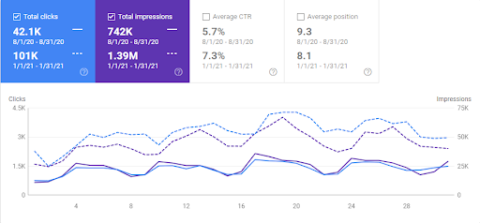
This article is very long and the content is quite in-depth. Most of the things mentioned in it are not accessible to ordinary SEOs, but it would not be a bad thing to know more concepts and techniques! I recommend everyone to make a cup of coffee and find some time to sit down and read.
link:Encazip.com optimization case
Beta testing - Meet the journalists behind the news content
Google has always been committed to improving users’ trust in search results.Search Guide EAT, news articles onFull Coverageand fact-checking... can be seen. Now there is a new feature in beta testing. This feature allows users to search for a reporter's name and an "Articles" carousel will be included to include articles written by the reporter in the past.
While this new feature is currently limited to a small group of journalists in the US, I thought it was worth mentioning. More experienced SEO people may have heard ofrel="author"This tag, "authorship" is what Google used toever wantedfailed, because it's so difficult to accurately connect "content" to "author" on the web, and this update may be Google's attempt again.
Interactive Onpage SEO Guide
This is from Siege MediaSEO Guide The content ofis relatively basic, but quite comprehensive. I think it is very suitable for writers to read. My own experience in dealing with writers is that it is not OK when a writer cares "too much" or "doesn't care too much" about SEO, and this article gives a good balance point.
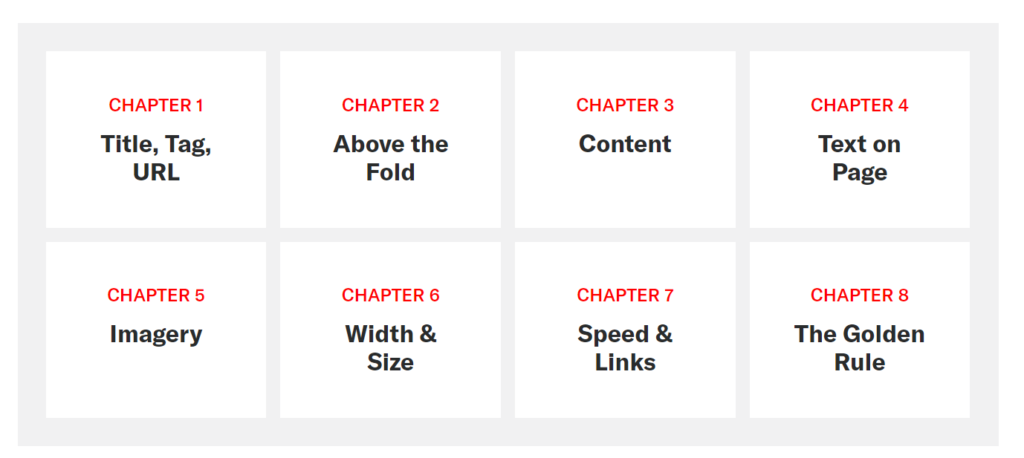
Another thing worth mentioning is the interactive design of this webpage. When you scroll down, the picture on the right will change accordingly (PC version). This design makes the content easy to digest even though it is very long. It is worth learning. Here is another similar oneWeb Design. After SEO enters a certain field, it is difficult for it to overlap with UX. After all, no matter how SEO-optimized the text content is, it will be in vain if there is no good presentation method to make readers want to read on.
Google: This search result is changing rapidly
In order to cope with emergencies that have just occurred and when there is relatively little trustworthy information on the Internet, users may be misled by the content of low-authority websites in their search results. In the future, users will be proactively notified in the search results –「It looks like these results are changing quickly」。
Starting in April 2020, Google also began to launchAnother notificationtells users that they did not find a highly matching page, directly admitting that it is not perfect.

Core Web Vitals comparison of various website technologies
by Google Data Studio dashboard made byRick Viscomi, combined withCrUXandHTTP Arvhiedata to monitor the performance of each web technology on CWVs.
Previous reports can only see the CWV performance of each website, but they cannot see the average performance of the technology behind each website on the CWV. Although a website may use multiple technologies, and technology is not the only variable that affects website performance, from this perspective, we can at least see which technology types (such as CMS, JS architecture, etc.) may be more performance friendly.
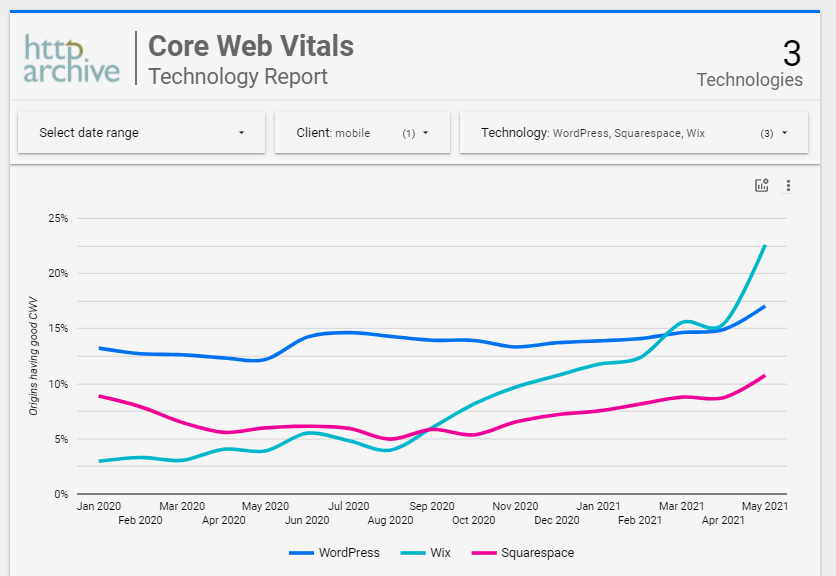
Another website that compares React, Vue, Angular... and other website architectures -Perf Track
link:Rick introduces this dashboard
Official new document - How HTTP status codes affect Google search
Google posted thisnew documentis talking about how Googlebot treats various HTTP status codes, and firewall or DNS settings...etc. cause Googlebot to not be able to see the content of the web page.
The content is much more interesting than I expected. For example, in the picture below, Googlebot will only follow up to 10 redirects, and then they will display a redirect error. In addition, the 301 vs 302 dispute has a clearer explanation. 301 has a stronger signal to tell Google that the target page is a standard page.

In addition, there are 4XX errors other than 429 (too many requests), which are treated equally by Google; and 204 (no content) will be regarded as soft 404; there are also418This status code comes from the humor of this developer. I recommend everyone to read it!
official new document - redirection and Google search
The main purpose of redirection is to let users and Google know what the new destination URL is when the URL changes. Although it usually has no impact on users, there are two main types of redirects for Google - permanent redirect and temporary redirect.
Regardless of permanent or temporary redirection, there are many ways to achieve it, including the familiar 301 and 302; JS redirect; meta refresh; and the ones that have caused heated discussions abroad.Crypto Redirect. This new term sounds cool, but it actually just refers to putting a message on the original web page and a normal hyperlink to the new web page, which is more or less like this: 😂
<p>嘿,我們搬家了,請到<a href="https://www.newsite.com/">這裡</a>進入我們新的網站</p>

In addition, the last paragraph of this document is also very interesting. He said that when a URL is redirected (such as A redirect to B), Google will select one from the original web page (A) and the target web page (B) based on the strength of the signal as the canonical URL, and the other will become the alternative name of the canonical URL. Usually the standard URL will appear in the search results, but the alternative name may also appear due to the user's specific search terms (ex:site:) appears.
link:Google forwarding documentation
[Abstract] Google Search Podcast – Google I/O & Information Search
Google IO 2021
Martin said that he doesn't think there is a need for more search-related speeches at developer conferences like Google I/O, because compared to things like Google Cloud or Tensorflow, which have a direct impact on developers, if Google does a good job in search, developers actually have nothing to worry about.
Gary added that there have always been two groups of voices in Google. One group prefers not to disclose the details of search to the outside world, because ideally Google can perfectly understand a web page or website, and webmasters do not need to do anything special to technically "optimize" SEO; while the other group acknowledges Google's shortcomings in search and communicates externally so that SEOs know how to help Googlebot understand the website.
Structured data is a good example. Imagine if Google's technology can directly understand the content on the web page and "structure" it in a few years. Then webmasters will not need to put structured data such as schema markup. However, the current situation is that Google is still far from perfect.
The two voices mentioned by Gary are actually understandable. I think that in the long run, SEO skills are still necessary to understand what information users need, how to search, and how to produce content. As for technical SEO, the correct mentality should be to help Google better understand the content of the website, rather than trying to exploit Google's shortcomings and trying to gain benefits from it.
Information Retrieval
Gary mentioned it in a previous podcastquery parsing & query understanding, that is, when the user searches for a word, Google will expand it into more related words, and then search it in the index database; and this search action is the so-called information retrievel. A simple understanding is to determine whether a file contains certain information. This step usessign postingOnly by waiting for technology to improve efficiency can relevant results be found in the shortest time.
In information retrieval, when judging related words, an interesting little knowledge is - "buy car" and "sell car" are possibleregarded as "synonyms"", because when a user is searching for an item to "buy", even if the word "sell" is used on the web page, it is very consistent with the user's search intention.
The above steps only find all related web pages or files. This step gives each web page a rough score. Assuming that there are 1 billion related web pages for a search term, they will sort them and take the top 1,000 or so web pages. The results provided at this stage are actually quite good, but they are only ranking results based on some basic signals, and the entire ranking process is not completely over. These 1,000 web pages need to go through more signals and be reordered before they are the last search results that users see.
link:verbatim
Crypto Redirect has caused heated discussions among everyone about what it has to do with the blockchain, but John and Gary’sexplainSays this is their internal term, and Matt Cutts said it back in 2006crypto-404Such words are quite interesting, and I am also looking forward to the official Chinese translation in the future. SEO to the moon!